

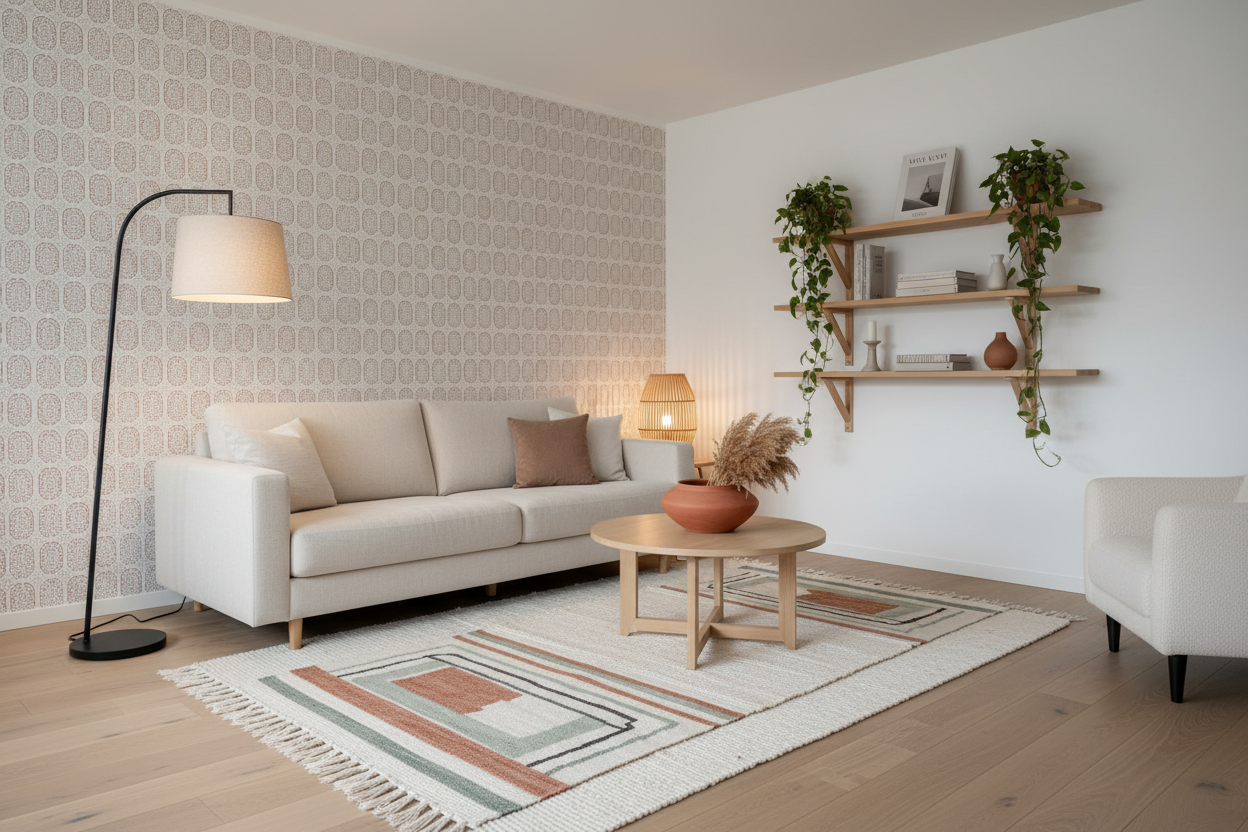
How to Decorate a Rental Apartment Without Making Changes: The Method for a Space That Feels Like Yours
Meta description: How to decorate a rental without works and without losing the deposit — ah, the deposit! Light, layout, colours and reversible solutions for a space that truly feels like yours.
How do you decorate a rental apartment without making changes? By starting from what you can change, not from what you can't touch. People who rent often feel like they're living in a temporary place that doesn't reflect who they are. That feeling doesn't come from the contract: it comes from the absence of a project. With a precise plan, even without touching a wall, a rental apartment can become a space you feel is completely yours.
In short: 70% of what transforms a space — light, textiles, furniture layout and the colours of objects — doesn't require any major works. It requires intention. And intention, without a design approach, almost always dissipates into scattered purchases that don't speak to each other.
What you'll find in this guide. The method to transform a rental without losing your deposit, the reversible solutions that make the real difference, how to manage wall colours without painting, layout as the first tool of transformation, and the role of light as the most powerful and least expensive variable available to renters.
The Problem with Renting
Renters often find themselves in a paradoxical situation. They spend most of their lives in a space they can't permanently modify, and this limitation becomes an excuse not to invest even in what could change.
The result is a home that never feels completely inhabited. Flat-pack furniture assembled in a hurry, the landlord's white walls left untouched, the original lights nobody has ever thought to change, pictures leaning against walls instead of hung because "I'll have to fill the holes later."
But most of what makes a space personal, visually coherent and pleasant to live in doesn't require works. It doesn't require touching the walls, it doesn't require the landlord's permission, and it doesn't put your deposit at risk — which most of us have lost at least once in our lives.
The catch, as we said, is that it requires a minimum of design thinking!
Layout Is the First Thing, Not the Last
This is the change that makes the most difference, and that almost nobody makes: moving the furniture.
The default arrangement of furniture in a rental is almost always whatever the previous tenant left, or the most obvious configuration dictated by the position of sockets and windows. That doesn't mean it's right for how you actually use the space.
Before buying anything new, it's worth experimenting with different layouts. The sofa doesn't have to be against the wall. The bed doesn't have to be centred on the window. The dining table doesn't have to be next to the socket. Moving furniture costs nothing and often produces the most significant change of all.
The right questions to ask before moving anything:
How do I enter this room and where does my eye naturally go? That's where the main piece of furniture should be — not necessarily where it already is.
Where do I spend the most time in this room? That zone deserves the most design attention.
Is there a view — even a small one — that a piece of furniture is blocking? Freeing it can completely change the perception of the space.
Light Is the Most Powerful Tool Available
This is the truth that changes everything for renters: lighting can be completely transformed without touching the electrical system.
The original lights in a rental are almost always central ceiling fixtures with cold white light, chosen for durability rather than quality of life. That lighting isn't part of the rental contract: it's a fitting that can be supplemented and nearly replaced with plug-in lamps.
What you can do:
Buy 2700K bulbs and replace the existing ones. This has the highest impact-to-cost ratio of all the solutions available to renters. It costs under ten euros and completely changes the atmosphere of a room.
Add floor lamps and table lamps on plugs that create ambient light and reduce dependence on the central ceiling fixture. A floor lamp in a corner of the living room costs between €60 and €150 and completely transforms how that space feels in the evening.
Use battery-powered or rechargeable lights to create light points where there are no sockets. Quality LED candles, rechargeable LED strips, portable outdoor lamps: all tools that add light without any wiring.
Colour Without Painting
Colour is what would most personalise a space, and it's what renters most often give up on because "I can't paint the walls."
But colour doesn't only live on walls.
Textiles as a colour palette
Curtains, cushions, bedspreads, rugs: these are the colour palette of a space, and they come with you when you move. Choosing textiles with the same logic used to choose wall colours — defining a palette of two or three colours first and respecting it with every purchase — produces a much more visually coherent result than any random combination.
Removable wallpaper
In recent years the quality of peel-and-stick removable wallpaper has improved enormously. There are products that apply and remove without leaving traces, with a visual effect very similar to traditional wallpaper. A single wall treated with removable wallpaper completely changes the character of a room.
Furniture as colour accents
A coloured piece of furniture — a forest green sideboard, a terracotta bedside table, a navy blue bookcase — brings colour into the space without touching the walls. These work best against a neutral background, which the rental's white walls often already provide.
Reversible Solutions That Actually Work
Pictures and posters without holes
Quality adhesive hanging systems — Command Strips or rail systems applied with double-sided tape — hold significant weights without damaging walls. Hanging pictures instead of leaning them makes an enormous difference to how a room feels: the space seems inhabited and considered rather than temporary.
Plants as green architecture
Large plants — a monstera, a fiddle-leaf fig, an indoor olive tree — do for spaces what large furniture does: they define zones, create height, give character. A large plant in a corner of the living room costs €40-80 and transforms the space visually like nothing else at the same price.
Rugs as space definition
In a rental with the landlord's parquet or the neutral tiles you can't change, the rug is the tool with which you define the space. A large rug under the sofa and coffee table creates a living zone with a precise identity. A rug in the bedroom in front of the bed creates warmth and character without touching anything.
The rule already mentioned still applies: the rug must be large enough to contain at least the front legs of the sofa. A rug that's too small makes the space look poorer, not more restrained.
Furniture you take with you
This is a change of perspective that makes a real difference: instead of thinking "I can't buy anything nice because I'll have to move," think "I buy quality pieces because I take them with me." A good sofa, a design lamp, a bookcase that works: these are investments that travel with you, apartment after apartment, and keep working wherever you go.
Budget: How to Allocate It Without Waste
Renters often make one of two opposite mistakes. Either they invest nothing in the space because "it's not mine anyway," or they buy lots of small things without a logic that don't speak to each other.
The right hierarchy for renters:
Light first. 2700K bulbs, a floor lamp, a table lamp. Budget: €60-200. Immediate impact on the whole space.
Then the rug. The right size, the right one for the space. Budget: €80-250. Defines the space more than any other single purchase.
Then textiles. Cushions and curtains in the chosen palette. Budget: €100-300. Bring colour without touching the walls.
Then one strong piece. A piece of furniture, a lamp, an object with character. Budget: variable. This is what gives the space its identity.
Then plants. One large one instead of ten small ones. Budget: €40-80.
What you don't need: lots of small decorative objects, leaning pictures, makeshift curtains, coloured containers, matching bathroom accessories.
When It's Worth Calling a Professional
Even for renters, a professional consultation can make the difference between a space that "almost works" and one that really works.
Not to make changes: to have a project that establishes the right palette for the white walls that are already there, the optimal layout for those pieces of furniture in that room, and a shopping list that avoids the pointless purchases that accumulate over time.
The Restylit Basic consultation at €129, with a 45-minute video call, is designed exactly for this situation: you don't need renderings or technical drawings, you need a professional eye that tells you where to put things and what to buy to get the maximum result with the available budget.
Do you rent and want a space that finally feels truly yours? The Basic consultation (€129, 45-minute video call) starts from how your apartment looks now and tells you exactly what to do, without any works. Book now →
If you also want to see how the space could look with a photorealistic rendering, the Basic+3D consultation (from €249) includes that too. Discover the Basic+3D package →
FAQ
What can you do in a rental without the landlord's permission? Almost everything reversible: changing bulbs, adding plug-in lamps, moving furniture, using removable wallpaper, hanging pictures with quality adhesive systems, adding rugs, plants and textiles. What almost always requires the landlord's permission is painting the walls, drilling into load-bearing masonry, modifying electrical systems and installing fixed elements.
How do you personalise a rental with white walls? White walls are actually an advantage: they're the neutral background on which any colour choice stands out well. Colour comes through textiles (curtains, cushions, bedspread), furniture with a precise chromatic character, plants, pictures hung with adhesive systems, and removable wallpaper on a single wall. Choose your palette first and respect it with every purchase.
Is it worth investing in the decor of a rental? Yes, with a clear logic. Quality pieces you take with you — sofa, lamps, bookcases, rugs — are investments that keep working in every future apartment. Pieces you can't take, like curtains made to measure for those specific windows, should be assessed case by case. The rule: if it's good and works here, it'll probably work in the next apartment too.
How do you make a rental look bigger? The same rules that apply to any small space, with the reversibility constraint. 2700K light distributed across multiple points instead of just the central ceiling fixture. A large rug that defines zones instead of fragmenting them. Furniture layout that lets the depth of the room show. A large mirror positioned opposite the window. Coherent colours and textiles instead of fragmented ones.
Restylit is an Italian interior design company, entirely online. Photorealistic 3D renderings, shoppable lists, technical drawings for the contractor. Over 500 completed projects, 4.8/5 on Trustpilot.


