

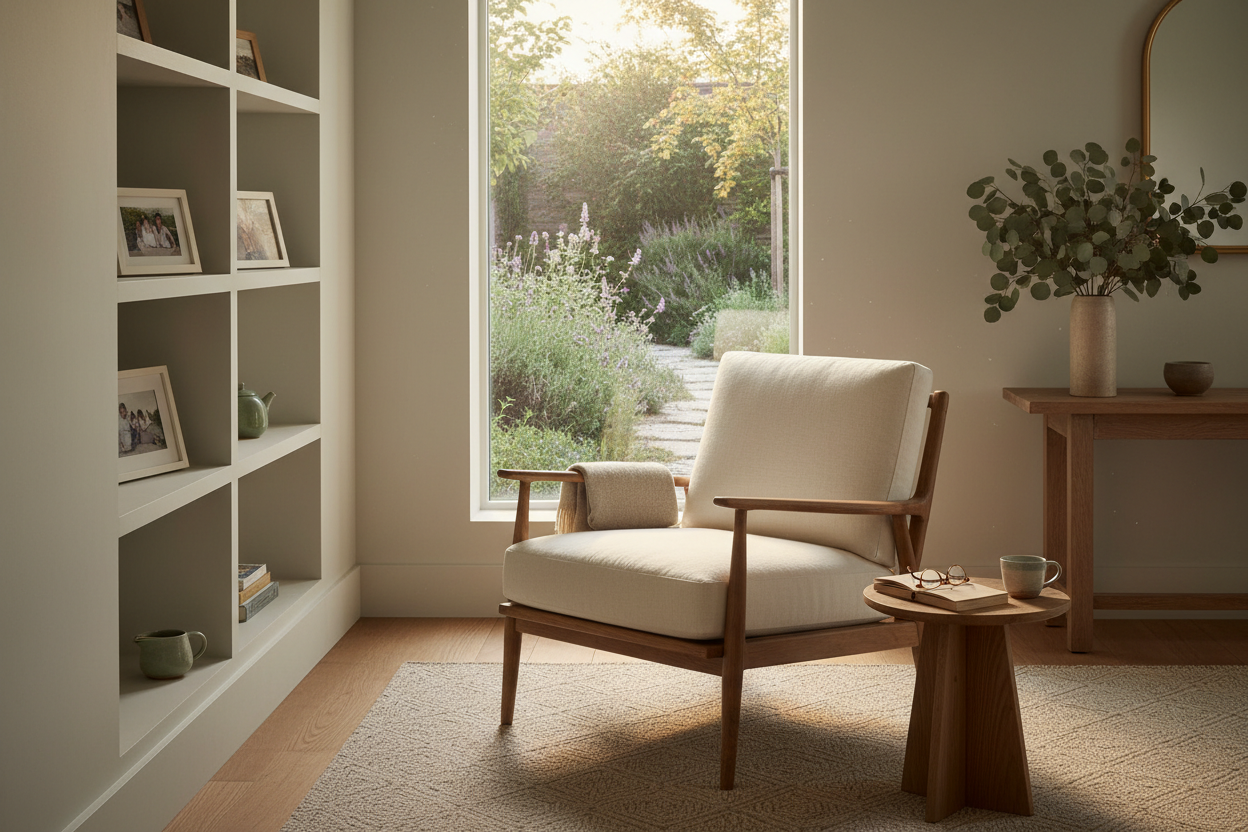
A Restylit study on domestic identity, life transitions and interior design in 2026
What happens to a home when the children leave? In Italy, this question arrives on average when the child is 30 years old — four years later than the European average of 26.2 years (Eurostat, 2024). The Italian delay in leaving the family home is structural and has been stable for over twenty years, which means that Italian parents live through this transition later and often more suddenly than their Northern European counterparts. When it happens, almost nobody has thought in advance about what to do with the house.
In short: the moment the last child leaves the parental home is one of the main triggers for renovation and redesign of domestic space. Not because there is less space, but because the space that exists has stopped corresponding to the people who live in it.
The Italian Demographic Context
ISTAT 2025 demographic data paint a precise picture: the average age of the resident population in Italy has reached 46.8 years, growing steadily. Single-person households now represent 37.1% of all family units. The fertility rate has fallen to a historic low of 1.14 children per woman.
This combination of factors produces a specific effect on the Italian housing landscape: millions of couples and single adults between 50 and 65 find themselves, for the first time in decades, living in homes designed and organised for a large family that no longer exists.
In Italy, according to Eurostat 2024 data, the average age at which young people leave the parental home is 30.1 years, one of the highest in Europe and almost four years above the EU average. This means the transition moment arrives when parents are on average between 55 and 65 years old — a stage of life when priorities, habits and needs have changed significantly compared to when the home was organised for family life.
The Psychology of Transition: What the Research Says
The scientific literature on empty nest syndrome documents the emotional impact of this transition in consistent terms.
A systematic review published in the Journal of South Asian Federation of Menopause Societies in 2025, which analysed studies from 2000 to 2024, concluded that empty nest syndrome can contribute to depression, anxiety and somatic symptoms, but also offers opportunities for personal growth, marital renewal and redefined parent-child relationships.
Research published in Communications Psychology in 2024 highlighted how cultural contexts significantly influence parents' experience during this period, with collectivist-oriented societies — such as Italy — showing more intense emotional responses than individualist ones.
What psychological research reveals, and what is rarely connected to the design dimension, is that the physical environment plays an active role in the transition. The child's room that remains unchanged for years, with the adolescent posters still on the walls and the single bed intact, is not simply an unused room. It is an identity marker that keeps domestic space anchored to a family configuration that no longer exists.
Environmental psychology calls this phenomenon "place attachment" and documents how the dissonance between the current identity of those who inhabit a space and the configuration of that space produces a subtle but persistent state of psychological tension.
From the Restylit Study: The Patterns That Emerge from Projects
In the analysis of projects followed by the Restylit team over the last three years, a recurring pattern emerges among clients in the 50-65 age bracket who find themselves facing the empty nest transition.
The children's room as an unresolved problem
In almost all cases, the child's room or rooms are left unchanged for an average period of 18-24 months after the departure. Not by deliberate choice, but for lack of a project for what to do with that space. The question "what do we do with it now?" remains unanswered not because the will to change is absent, but because there is no design framework for addressing it.
The redistribution of shared spaces
With fewer people in the house, shared spaces like the living room and kitchen are experienced differently. What was previously a space for family coordination potentially becomes a space for personal expression. But this transition, without a project, tends not to happen: the space remains configured for the past family rather than being redesigned for the couple or individual who lives there now.
The return to one's own needs
The empty nest phase often coincides with the first moment in an adult life when parents' individual needs become a priority over those of the extended family unit. For many people, especially women who have devoted decades to family management, it is the first time they can ask themselves: how do I actually want to live in this space?
The Three Most Frequent Transformations
From the analysis of Restylit projects in this demographic category, three recurring types of transformation emerge.
1. The children's room becoming a study or hobby space
It is the most requested transformation and the one with the greatest impact on daily wellbeing. A space that for twenty years was defined by the child's identity finally becomes an adult space: a study, a library, an atelier, a meditation zone, a space for music or craft.
The design challenge is not only functional but identity-based: the space needs to stop communicating "someone else used to live here" and start communicating "this space is for me." The change of wall colour, the choice of materials, the lighting: these are decisions that carry a psychological weight far greater than their technical one.
2. The redesign of the master bedroom
With children in the house, the parents' bedroom is often the least cared-for space of all: a place to sleep, not to be. Without the pressure of family life, the bedroom can become again an adult space — considered, personal. Restylit clients in this age bracket often invest in the bedroom more than in any other room, because it is the one that most transforms the quality of daily life.
3. The simplification of shared spaces
With fewer people in the house, shared space tends to lose functions. The large dining table for six becomes oversized. The play area is no longer needed. Storage zones for the children's sports equipment can be recovered. Simplification is not impoverishment: it is an opportunity to redesign spaces around the real life of whoever inhabits the home now.
The Italian Paradox
There is a specifically Italian element to this transition worth naming.
In Italy, the emotional bond between parents and children is on average stronger than in other European countries. The children's departure arrives later and tends to be experienced with greater emotional intensity. At the same time, the Italian culture of "we'll sort it out gradually" leads to postponing decisions about domestic space far more than in other contexts.
The result is a large, economically active demographic — willing to invest in the home — that has not yet found a cultural and design framework to address this transition consciously.
The empty nest in Italy is an enormous and almost completely unexplored design opportunity.
Restylit's Approach to the Empty Nest Transition
At Restylit we have developed a specific approach to accompany this phase, one that differs from the standard consultation for renovation or furnishing.
The starting point is not "what do you want to do with the children's room" but "how do you want to live in this home now." The question seems similar, but it produces very different answers. The first asks for a specific problem to be solved. The second opens a conversation about present and future domestic identity.
From that conversation almost always emerges a partial or total redesign project that goes well beyond the single room: a redistribution of functions, a new colour palette for the entire home, material and lighting choices that reflect who one is at 55, not who one was at 35.
The photorealistic 3D rendering we produce has a particular meaning in this context: showing how the home could look, freed from the imprint of past family life, is often the emotional catalyst that transforms a vague intention into a concrete design decision.
Are you going through this transition and want to understand how to rethink your home for how you want to live in it now? The free 15-minute call with the Restylit team is the right place to start this conversation. Book the free call →
If you already know you want to start a project, the Basic+3D consultation (from €249) includes photorealistic renderings that show how each room of your home could become. Discover the Basic+3D package →
References
Dwivedi M.A., Kondapalli S.S. (2025). Empty Nest Syndrome: Psychological, Social, and Cultural Perspectives. Journal of South Asian Federation of Menopause Societies, 9(2):50-52. ResearchGate
Eurostat (2024). Age of young people leaving the parental home. European Commission. Eurostat data analysis
ISTAT (2025). Annual Report 2025: The State of the Country. Italian National Institute of Statistics. istat.it
Khatir M.A., Modanloo M., Dadgari A. et al. (2024). Empty nest syndrome: A concept analysis. Journal of Education and Health Promotion, 13(1):269. LWW Open Access
Mitchell B.A., Lovegreen L.D. (2009). The empty nest syndrome in midlife families: A multimethod exploration of parental gender differences and cultural dynamics. Journal of Family Issues, 30(12), 1651-1670.
Hartanto A., Sim L., Lee D. et al. (2024). Cultural contexts differentially shape parents' loneliness and wellbeing during the empty nest period. Communications Psychology, 2(105). Nature — Open Access
Restylit is an Italian interior design company, entirely online. We design residential spaces with photorealistic 3D renderings, shoppable lists and technical drawings for the contractor, across Italy and Europe. Over 500 completed projects, 4.8/5 on Trustpilot.


