

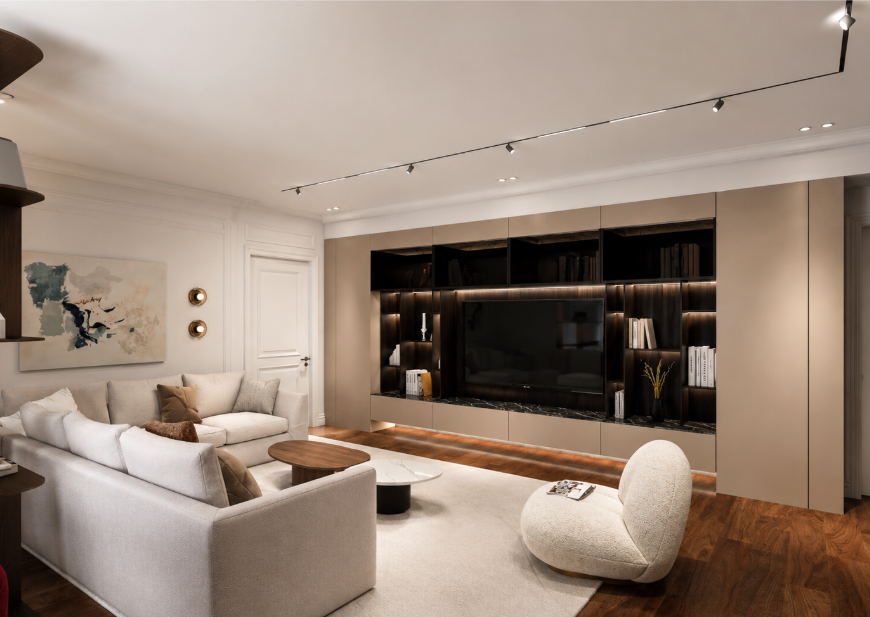
Furnishing a home from scratch: where to start and in what order
By Alberto Capuzzo, co-founder — Restylit | LinkedIn
Where do you start when furnishing a home from scratch? Not with the sofa. Not with wall colours. Not with Pinterest. You start with a question almost nobody asks themselves before buying anything: how do I want to live in this space? From that answer emerges a precise order of decisions that completely changes the final result and, in most cases, saves a significant amount of money by avoiding wrong purchases.
In short: furnishing a home from scratch is one of the most expensive and most potentially stressful moments of adult life. Almost everyone approaches it in the wrong order: big furniture first, then colours, then they realise something isn't working but it's too late to change. The right order is the opposite: the project first, everything else after.
What you'll find in this guide. The correct order of decisions when furnishing from scratch, what to do before you even walk into a shop, how to define a style without getting lost in inspirations, the right timing for each purchase and how Restylit helps those starting from zero avoid wasting money.
Framing the Problem
Furnishing a home from scratch has one enormous advantage over a restyling: no pre-existing constraints. You can choose everything, coordinate everything, start from a blank canvas.
It also has one enormous problem: too much freedom without a method produces paralysis or impulse buying. Without a guiding thread, every purchase becomes an island. The grey sofa that seemed perfect in the shop conflicts with the dark parquet. The rug chosen for the living room doesn't speak to the curtains. The bookcase bought on impulse doesn't fit the wall you had in mind.
These aren't mistakes of taste. They're mistakes of method. And method can be learned — or delegated to someone who has it.
First of All: The Project
This is the point that most changes the experience of those furnishing from scratch, and the one most often skipped to "save money."
An interior design project — even in its simplest form, a video call with a professional and a photorealistic rendering of the main rooms — answers three questions no furniture shop will ever answer for you:
What do you actually need in this space? Not what you think you want, but what you need for how you said you want to live in that home. The answer sometimes surprises: you don't need a second bedside table, you need a reading space. You don't need a table for six, you need a table for four that extends.
In what order should you buy things? Some purchases need to be made first because they condition everything else, and some can wait. Mixing them up costs money.
How much budget to allocate to each room? A professional tells you where it makes sense to invest more and where you can save without compromising the result. Almost always the answer surprises: too much is invested on decorative elements and too little on structural ones.
The Right Order
1. Floors and walls first — if they can be changed
If you're renovating or in a situation where you can choose the finishes, this is the first decision. Floors and walls are the backdrop for everything else: if you change them after buying the furniture, you risk them not speaking to each other.
If instead the floors and walls are already given — as in a rented apartment or one just bought without renovation — they become your starting constraints, not your choices.
2. The colour palette
Before buying any furniture, you decide the chromatic palette of the home. Not the exact colour of the walls, since that comes later. The direction: warm or cool, neutral or with accents, how many colours and which ones.
The palette conditions everything: the colour of the sofa, the textiles, the accessories, the bookcase. Those who define it last find themselves searching for something "that goes with everything" — an almost always frustrating and expensive search.
3. The layout of every room
Before buying a single piece of furniture, you draw the layout. You don't need to do it by hand on graph paper: a floor plan with the real measurements of the rooms and the position of doors and windows is enough.
The layout says: a three-seater sofa can fit here, not a two-and-a-half. The double bed only goes in that position here. The desk necessarily goes under the window here. Without the layout, you buy by eye and bring home something that doesn't fit, doesn't turn, doesn't let the door open.
4. Structural furniture
Structural furniture is what defines each room: the sofa, the bed, the table, the bookcase, the kitchen. It gets chosen after the layout — with precise measurements in hand — and before everything else.
These are also the pieces where it's worth investing more, because they last years and visually and functionally condition every room. A quality sofa in the wrong colour is recoverable. A quality sofa in the right colour is an investment that carries forward for ten years.
5. Lighting
Lighting is the most underestimated variable for those furnishing from scratch and the one with the highest return. Almost everyone thinks about it last, when the furniture is already positioned and the sockets are where they are.
Lighting should instead be designed alongside the layout: where sockets for lamps are needed, where the ceiling track goes, where natural light is sufficient and where it isn't. A well-designed lighting system — with dimmers, multiple 2700K sources, accent light as well as general light — transforms any space. An improvised one limits it for years.
6. Textiles
Curtains, rugs, cushions, throws: they are the colour palette applied to the space. They get chosen after the structural furniture because they need to speak to it, but before decorative accessories because they're the ones that most change the atmosphere of a room.
The rug deserves special attention: as we wrote in our dedicated article, it should be chosen in the right size and positioned so it contains the living group. An undersized rug is the single mistake that most frequently ruins an otherwise well-furnished living room.
7. Accessories and decor
Last, not because they're less important, but because they're the ones best chosen when everything else is already in place. A decorative object bought before seeing how it will work in the final context almost always doesn't function as expected.
It's also the category where it makes most sense to wait, as we said in our article on not furnishing everything at once: better a nearly finished space with a few well-chosen objects than one finished in a rush with many objects you don't love.
Timing: What to Buy Before Moving In and What Can Wait
Not everything needs to be bought before moving day. This is one of the most important liberations for those furnishing from scratch: the idea that the home needs to be "finished" on moving day is an artificial pressure that produces wrong purchases.
What to buy before moving in: The bed, since sleeping on the floor isn't an option. The fridge and kitchen essentials. Curtains in the bedrooms — for privacy and sleep. Basic lighting — at least one lamp per room.
What can wait: The sofa: you can live a few weeks without it, and those weeks help you understand how you use the living room. The dining table: same. All decorative accessories. The rug — it's one of those things best chosen after you've lived in the space a while.
Budget: How to Distribute It
Budget distribution is one of the most practical and least documented aspects of furnishing from scratch. Nobody tells you where it's worth spending and where you can save.
The rule that emerges from our experience across hundreds of projects:
Invest more on: the mattress (used every night for ten years), the sofa (used every evening for years), the kitchen (expensive to change), lighting (transforms everything), the main rug (defines the space).
You can save on: simple storage furniture (Ikea's Billy bookcases and chests of drawers are excellent value), decorative accessories (the flea market beats the concept store for objects), curtains (simple natural linen fabrics cost little and do a lot).
How Restylit Helps Those Starting From Scratch
The Basic+3D consultation is the tool that makes most sense for those furnishing from scratch, because it answers exactly the three questions no shop will ever ask you: what you need, in what order to buy it, where to allocate the budget.
The photorealistic rendering isn't a pretty drawing to look at: it's the map with which you make precise purchases instead of trial-and-error ones. It's the difference between an apartment that looks designed and one that looks assembled.
Are you furnishing a home from scratch and don't know where to start? The Basic consultation (€129, 45-minute video call) is the first step: it tells you what to do, in what order and where to focus the budget for your specific space. Book now →
If you want to see how your home will look before buying anything, the Basic+3D consultation (from €249) includes a photorealistic rendering of every room with the design choices specific to you. Discover the Basic+3D package →
FAQ
Where do you start when furnishing a home from scratch? You start with the project, not the purchases. First you define how you want to live in the space, then the colour palette, then the layout of every room with precise measurements. Only after that do you buy the structural furniture — sofa, bed, table — in the right sizes for that layout. Then lighting, then textiles, then accessories. Those who reverse this order almost always end up with purchases that don't work together.
How much does it cost to furnish a home from scratch? It depends enormously on the floor area, the quality of the furniture and how many things you buy new. As an indicative reference: a 70sqm apartment furnished with mid-range furniture requires between €15,000 and €30,000 in total. The optimal distribution means investing more on the mattress, sofa, kitchen and lighting, and saving on storage, accessories and decorative objects.
In what order do you furnish the rooms? There's no fixed order by room, but there is a purchase category order that applies to all rooms: first define the layout, then buy the structural furniture in the right sizes, then lighting, then textiles, then accessories. The kitchen is almost always the first room to complete because its installation works condition everyday use. The bedroom comes second for the bed. The living room can wait longer because it's used differently.
Is it worth having an interior design project when furnishing from scratch? Yes, and it's the moment when it makes most sense: before any purchase, when all options are still open. The cost of a professional project — between €129 and €249 for a Restylit consultation — is almost always less than the cost of the first wrong purchase it avoids. Those who furnish from scratch without a project almost always spend more in the long run: wrong purchases, pieces to replace, regrets to correct.
Restylit is an Italian interior design company, entirely online. Photorealistic 3D renderings, shoppable lists, technical drawings for the contractor. Over 500 completed projects, 4.8/5 on Trustpilot.


