

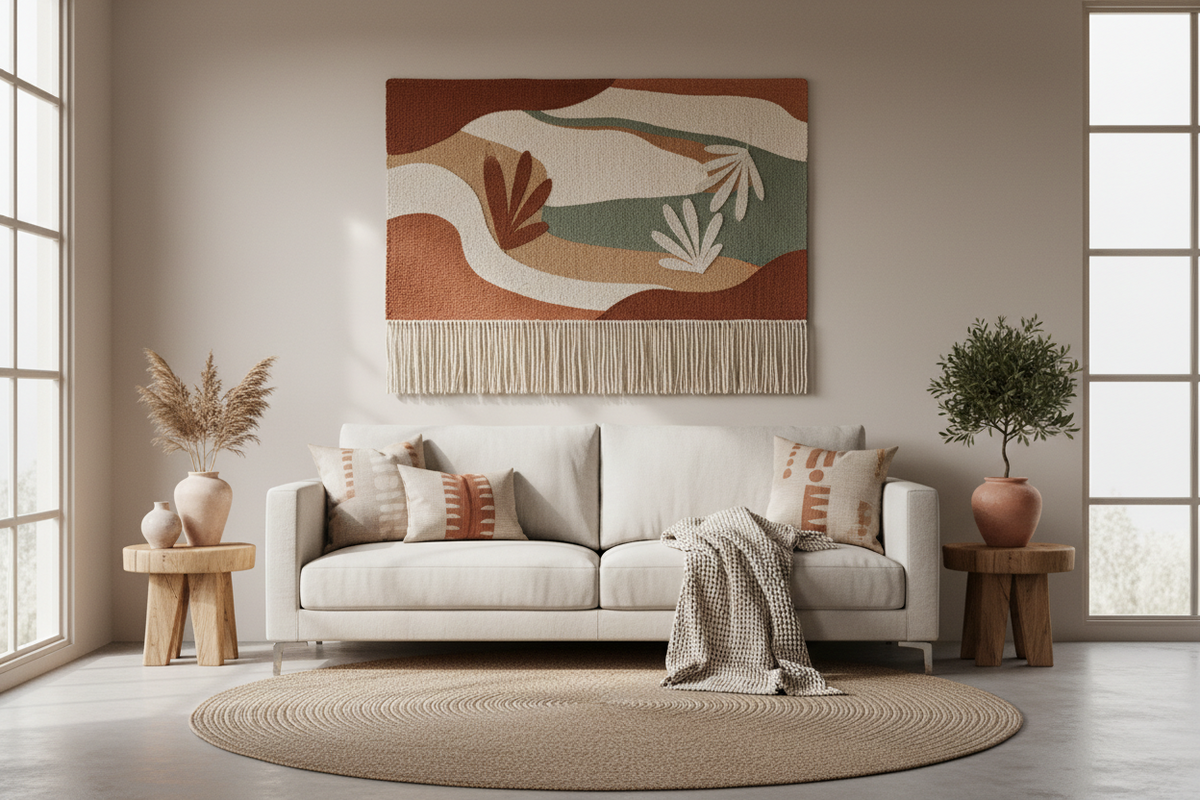
Wall textiles: why tapestries and wall hangings are replacing artwork
Why are tapestries and wall textiles replacing artwork? Because they bring something pictures simply can't: tactile depth, acoustic absorption, visual warmth and a presence that changes with the light instead of remaining flat. A natural wool tapestry on a wall isn't decoration: it's a material that interacts with the space, one you perceive before you even look at it directly.
In short: wall textile is perhaps the most original decorative trend of 2026, and one of the few with a functional reason beyond the aesthetic one. Contemporary spaces tend to have hard, reflective and reverberant surfaces. A textile on the wall reduces sound reverberation, adds tactile warmth and brings that material complexity which the tactile home — as we described in our dedicated article — seeks across every surface.
What you'll find in this guide. Why wall textiles work better than artwork in certain contexts, the types dominating 2026, how to choose a tapestry or textile in relation to the space, how to hang it without damaging walls, and how to pair it with the rest of the furnishings.
Why Wall Textiles Work Better Than Artwork
Before explaining how to use them, it's worth understanding why the trend has shifted in this direction.
Artwork is flat. A picture brings colour and visual composition, but it doesn't bring tactile depth. It doesn't change the acoustic perception of the space. It doesn't interact with light dynamically: it reflects or absorbs, but it doesn't transform.
Tactile visual depth. The weave of a raw wool tapestry or a woven cotton wall textile is perceptible even from a distance. The eye reads texture as depth, and that depth adds a dimension to the space that the flat surface of a picture simply can't provide.
Acoustics. Contemporary spaces with hard floors, smooth walls and few sound-absorbing surfaces reverberate a lot. A textile on the wall absorbs some of the sound waves and reduces that reverberation which makes environments feel harsh. It's not an acoustic panel, but the effect is measurable.
Visual warmth. Wool, cotton, linen, macramé: these are materials the brain reads as warm, safe, organic. Hung on a wall, they produce the same psychological response they produce on the floor or on the sofa: they communicate that the space is welcoming and protective.
Interaction with light. A textile with pronounced texture changes appearance as the light changes throughout the day. In the morning with raking light, the shadows created by the weave become visible. In the afternoon with diffused light, the texture flattens. In the evening under warm artificial light the material seems even warmer. This variability is alive: the textile is never quite the same as itself.
The Types Dominating 2026
Contemporary macramé
Macramé is the hand-knotting technique that produces those wall hangings with knots and fringing you see everywhere. It's not entirely new, but the quality of contemporary production has increased considerably compared to the kitsch macramé of the 1970s with which it's associated in most people's minds.
Contemporary macramé uses raw cotton, hemp rope, natural linen. The compositions are more essential, with fewer decorative knots and more attention to the overall form. The result is an object that brings texture and movement without looking decorative in a folksy sense.
It works best in neutral spaces, where its structural complexity doesn't compete with other loaded elements. A white or beige wall behind a natural linen sofa with a macramé hanging above: it's one of the most frequent and most successful compositions in contemporary warm minimalism.
Natural wool tapestries
Hand-woven tapestries, in raw wool in natural tones or a reduced palette, are the most sophisticated evolution of the wall textile. They're not necessarily large: even a 50x70cm tapestry has a significant visual presence if well positioned.
The productions going strong right now are those with thick texture, natural colours not chemically dyed, visible irregularities in the weave. Not industrial perfection: the mark of the hand of whoever made that piece.
Cost is the main limitation: a hand-woven wool tapestry can range from €80 for more accessible productions to several hundred euros for pieces by recognised craftspeople. But the lifespan is indefinite and the aesthetic value grows over time.
Decorative fabric panels
A more accessible and versatile category: panels in canvas, printed linen, patterned cotton, mounted on a frame as you would a canvas. Aesthetically similar to artwork in form, but with the material presence of a textile.
They're more easily found online and in mid-range furniture shops. The advantage is versatility: they can be changed without effort, they're lightweight, they hang easily.
Hung rugs
One of the most original trends: Berber rugs, kilims and dhurries hung on the wall instead of laid on the floor. It's not an aesthetic provocation: it has a precise logic. These rugs are objects with an enormous craft history and visual complexity, often too rich for the floor of a contemporary apartment. Hung on a wall, they become textile artworks.
A vintage kilim hung above a sofa in raw linen is one of the most powerful contrasts you can create in a living room, at a relatively modest cost if you find a quality second-hand kilim.
How to Choose the Right Textile for the Space
Choosing a wall textile follows the same logic as choosing any other decorative element: it must speak to what's already there, not compete with it.
In relation to the colours of the space
A textile with neutral and natural colours — beige, off-white, dove grey — works in almost any context because it never conflicts with the existing palette. It's the safest choice and often the one that produces the most elegant result.
A textile with an accent colour — sage green, terracotta, ochre — works when that colour is already present in the space in at least one other element. A cushion, a rug, a decorative object. The wall textile must not be the first element of that colour: it must be the confirmation of a palette already defined.
In relation to the scale of the space
A large textile in a small space doesn't overwhelm if the ceilings are high and the rest is neutral. A small textile in a large space disappears if it's not accompanied by other elements that confirm its presence.
The practical rule: the main textile should occupy at least 30-40% of the width of the wall on which it hangs to have significant visual presence. Below that proportion it reads as a secondary element rather than a focal point.
In relation to the texture of other materials
A raw wool tapestry on a smooth wall in an apartment all hard surfaces brings a very strong tactile contrast — which is exactly what's needed. The same tapestry in a space already rich in textiles could become excessive.
How to Hang Without Damaging the Walls
This is the practical point of most interest to renters or those who don't want to drill into their walls.
The wooden dowel system
The most classic and versatile method: a wooden or bamboo dowel threaded through the top of the textile or fixed to the back with small rings. The dowel is hung with two nails or quality adhesive hooks.
The advantage is that the weight is distributed evenly across the full width of the textile. The result is a clean, even drop of the fabric.
Quality adhesive systems
For those who don't want to make holes, 3M Command strips in large sizes hold up to several kilograms. They're not suitable for heavier thick wool tapestries, but they work well for lightweight fabric panels and less heavy macramé pieces.
Cord and branch suspension
One of the most photographed compositions: the textile hung with a natural cord from a branch or raw wood dowel, with the ends falling freely beyond the textile. It's a decorative solution that also showcases the hanging system itself, making it part of the piece.
The wall-frame technique
For printed fabric panels, the cleanest solution is to mount them on a wooden frame as you would a canvas. The fabric is stretched over the frame and hung like a picture. There's no fringing, no free fall: the result is more formal and geometric.
How to Pair Wall Textiles with the Rest of the Furnishings
Wall textiles work best when they're part of a coherent project, not when they're added as a decorative element to a space that's already defined.
The ideal context is that of the tactile home we described in our dedicated article: natural materials, neutral palette, a few objects chosen with care. The wall textile is the element that completes that material language, bringing vertical texture into a space already rich in horizontal texture — that of the floor and the rug.
If instead the space already has many patterns, many colours, many decorative objects, adding a wall textile risks becoming one more element in an accumulation already underway. In that case, the work to do first is to remove, not add.
The pairings that work best:
A natural wool tapestry above a bouclé sofa creates a texture dialogue that's much more interesting than the sofa alone. The two materials speak the same tactile language.
A raw cotton macramé on a beige wall in a space with a natural wood floor: the trilogy of organic materials produces that tactile coherence of warm minimalism.
A kilim hung above a bed with natural linen bedding: a contrast of material cultures that works because both materials have visible craft roots.
How Restylit Uses Wall Textiles
Wall textile has become one of the elements we specify most frequently in Restylit project shopping lists, especially in contexts where you want to add character without making any changes to the space.
It's one of the interventions with the best ratio of visual impact to reversibility: you hang it, it transforms the space, you remove it without leaving significant traces. For renters it's often the decorative choice with the highest return on investment.
Looking for a way to give character to a wall without buying artwork or making any changes? The Basic consultation (€129, 45-minute video call) helps you identify which type of textile works in your space and where to position it for maximum impact. Book now →
If you want to see how the textile will look in your specific room before buying, the Basic+3D consultation (from €249) includes a photorealistic rendering. Discover the Basic+3D package →
FAQ
What is wall textile art in interior design? Wall textile art is the use of tapestries, macramé wall hangings, fabric panels, kilims and rugs hung as vertical decorative elements, as an alternative to or complement of artwork. It differs from pictures through its material presence, acoustic absorption, visual warmth and ability to interact with light dynamically.
Which wall textiles are trending in 2026? The most sought-after types in 2026 are contemporary macramé in raw cotton or natural hemp, hand-woven wool tapestries with visible irregularities, printed linen panels mounted on frames, and vintage kilims or Berber rugs hung as artworks. All share a visible craft quality and natural materials that haven't been chemically dyed.
How do you hang a tapestry without making holes in the walls? Quality Command adhesive strips hold up to several kilograms and work well for lighter textiles. For heavier thick wool tapestries, a wooden dowel with two adhesive hooks distributes the weight better. The safest solution for very heavy pieces remains a nail, which in a rental leaves a hole of just a few millimetres that's easily repaired.
How do you pair a tapestry with the rest of the furnishings? A tapestry speaks best with materials that share the same tactile language: a bouclé sofa, a wool rug, a cashmere throw. The tapestry's palette should be present in at least one other element of the space before the textile is hung. It shouldn't be the first element of that colour: it should be the confirmation of an already-defined direction.
Restylit is an Italian interior design company, entirely online. Photorealistic 3D renderings, shoppable lists, technical drawings for the contractor. Over 500 completed projects, 4.8/5 on Trustpilot.


