

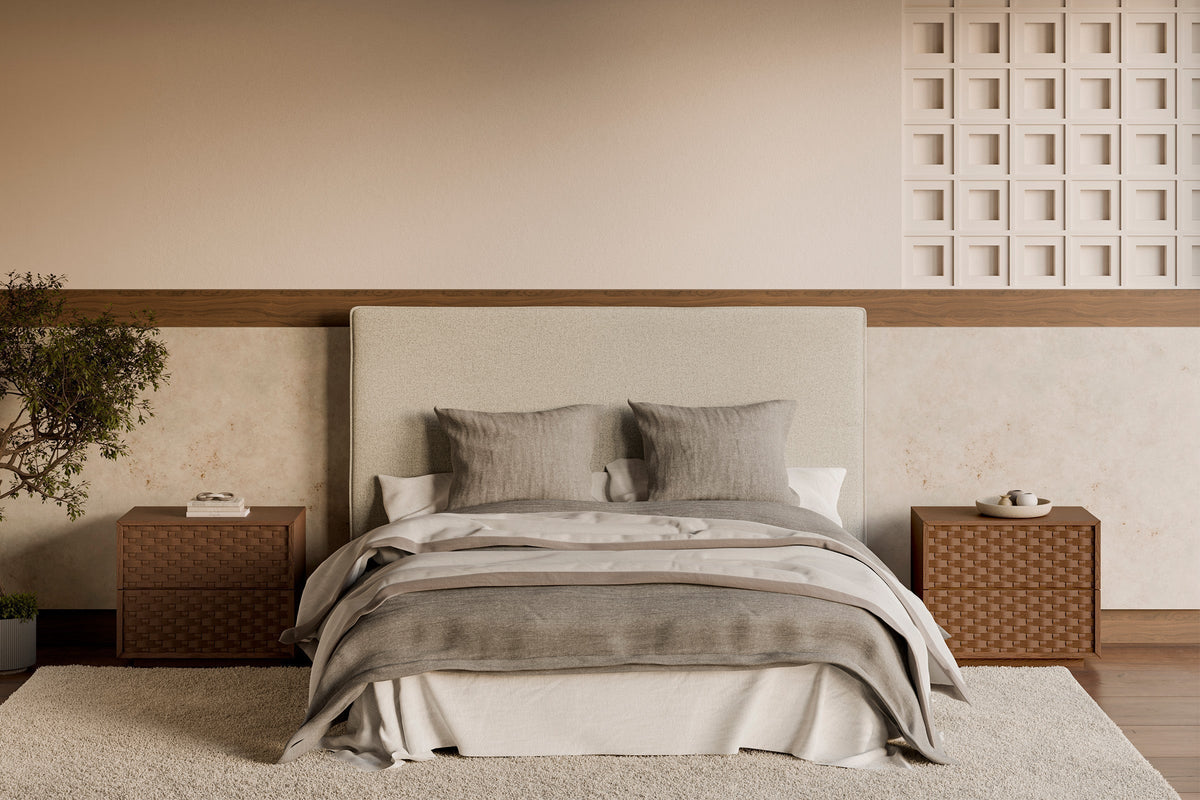
The bedroom as a hotel space: how to design a room that truly restores
How do you transform a bedroom into a space that restores like a hotel? Not by buying the right bedlinen or the most expensive mattress. But by designing the environment so that every variable — from light to colour temperature, from layout to the type of textile — actively supports rest instead of obstructing it. The difference between sleeping in a good hotel and sleeping at home is almost never the comfort of the bed. It's the quality of the environment surrounding it.
In short: the bedroom is the most neglected domestic space in Italy and the one with the highest impact on daily wellbeing. Those who sleep badly in a poorly designed environment don't restore, regardless of how many hours they spend in bed. A precise bedroom design project is one of the investments with the highest return on quality of life.
What you'll find in this guide. Why good hotels make you sleep well (it's not the mattress), the environmental variables that measurably influence sleep, how to design a bedroom that truly restores, the right materials and colours, the optimal layout, and the connection with the unplugged room theme we covered in a dedicated article.
Why You Sleep Better in Hotels
I have a theory about this, one that's been confirmed over time while working on dozens of bedrooms in our projects.
The reason you sleep better in hotels is almost never the mattress. Good hotel mattresses are quality, of course, but they're not necessarily better than ones you could buy yourself. The reason is environmental.
In a hotel room there's no clutter — just the bed, the right light, well-blackout curtains, a pleasant temperature and no visual signals that relate to work, responsibilities or daily life.
The brain doesn't choose to relax. It relaxes in response to the environmental signals it receives. And in a hotel those signals all say the same thing: this is the place for rest. At home, that's almost never the case.
The Environmental Variables That Influence Sleep
Research into environmental psychology and sleep medicine consistently documents that these physical variables have a measurable impact on the quality of rest.
Evening artificial light
Light at 4000K or above during evening hours suppresses the production of melatonin, the hormone that regulates the sleep-wake cycle. A cold bulb on the bedside table read under for an hour before sleeping delays sleep onset by 30-60 minutes on average.
The solution is simple and costs under ten euros: 2700K bulbs in the bedroom, dimmable if possible. The difference is perceptible from the very first evening.
Blackout
External light filtering through lightweight curtains interrupts sleep during the lightest phases. Complete, or near-complete, darkness significantly improves the quality of deep sleep. Blackout curtains aren't a luxury: they're a functional tool.
Visual noise
As we wrote in our article on the unplugged room, the mere visual presence of objects associated with work, stress or responsibilities keeps the nervous system in a state of subtle alertness that interferes with relaxation. A bedroom with a laptop screen visible, emails open on a phone, work documents on the bedside table, is not a rest environment: it's a work environment with a bed in it.
The chromatic temperature of the environment
Warm and desaturated colours — in the tones of beige, greige, sage green, blue-grey — communicate calm to the nervous system. Bright and highly saturated colours produce a state of activation. The bedroom palette is a functional choice as much as an aesthetic one.
The Layout That Supports Rest
The bed as the centre of the environment
The bed isn't a piece of furniture like any other: it's the functional and visual centre of the bedroom. The layout must start from there. The bed goes where it makes most sense in relation to the window, the door and the light sources — not where there's the most free space.
The classic position that works best in almost all bedrooms is centred on the main wall, with access from both sides. This guarantees visual symmetry, ease of use and the feeling of a bed that occupies its place with intention instead of having been put where it fitted.
Distance from the window
The bed shouldn't be positioned under the window if morning light can disturb sleep. It should be positioned so that the sleeper has the window to the side or facing them, not above their head. Morning natural light entering from the side supports waking naturally. Light entering from above breaks sleep in the last hours of the night.
Space around the bed
A minimum clearance of 60 centimetres on both sides of the bed is the minimum to avoid feeling cramped. 80-90 centimetres is the measurement that allows comfortable movement. Sacrificing this space to fit in a piece of furniture that isn't necessary is almost always a choice you'll regret.
The door shouldn't be visible from the bed
This is guidance that comes from environmental psychology and feng shui design tradition, but it has a precise functional basis: sleeping with the door directly in the visual field keeps the nervous system in a higher state of alertness. It's not superstition: it's how the autonomic nervous system functions when it perceives a potential entry point into the space.
Hotel Bedroom Materials
Bedlinen
This is the investment with the highest return in terms of sleep quality. High-density percale cotton, washed linen, Egyptian cotton: all materials that breathe better than synthetics, regulate temperature and age well over time.
The thread count that matters isn't the one printed on the label, often inflated by marketing: it's the quality of the fibres. Good 200-thread percale cotton is superior to a 1000-thread synthetic blend.
Soft and absorbent textiles
Blankets, cushions, a rug at the foot of the bed: in a hotel bedroom these elements aren't decorative. They absorb sound, create tactile warmth and communicate to the body that it's in a safe place to relax.
A natural fibre rug at the foot of the bed — the first contact with the floor when you wake up — is one of those elements that subtly but consistently changes the quality of waking.
Curtains
Bedroom curtains need to do two things: block light well when needed and control natural light when you want it to come in. Double curtains, with a blackout panel and a translucent one, are the most flexible solution. Single blackout curtains are the most effective solution for those who have issues with morning light.
Curtains should always be mounted near the ceiling and reach to the floor: this visually lengthens the wall, makes the window appear larger and the room feel taller.
Bedroom Colours in 2026
2026 confirms a clear trend toward the bedroom as a chromatic refuge. Deep, enveloping, desaturated colours: moss green, blue-grey, muted chocolate brown, deep greige.
The bedroom in colour drenching, as we described in our dedicated article, is the most effective application of that technique in the entire home. A deep and desaturated colour that completely surrounds you creates that cocoon sensation that good hotels replicate through the design of walls, curtains and textiles.
Pure white in a bedroom is the choice least suited to rest: it reflects too much light, doesn't create the sense of envelopment and doesn't change character between day and evening. Warm neutrals — beige, greige, ivory — are already better. Deep desaturated colours are the choice that works best for sleep quality.
The Bedroom and the Unplugged Principle
In our article on the unplugged room we wrote that the bedroom should be the only space in the home excluded from technology. Not because technology is the enemy, but because the brain associates screens with a state of activation that is the opposite of what's needed for good sleep.
In a hotel bedroom there's no laptop. There's a television, but it's distant from the bed and turns off from the main switch when you go to sleep. There's no desk. There's nothing that suggests productivity.
Applying this principle at home doesn't mean giving up technology everywhere: it means keeping the bedroom as a zone protected from the visual noise of work and responsibilities. A book instead of a phone. A lamp instead of a screen. A clear bedside table instead of a depot of cables and devices.
How Much Does It Cost to Design a Bedroom
The bedroom doesn't require a high budget. It requires precise choices in the right order.
| Item | Indicative cost | Priority |
|---|---|---|
| Quality bedlinen (linen or percale) | €80-250 | High |
| Ergonomic pillows | €60-150 per pair | High |
| Blackout curtains mounted near ceiling | €100-300 | High |
| 2700K dimmable bulbs | €20-50 | High |
| Rug at foot of bed | €80-200 | Medium |
| Wall colour (one or four walls) | €50-200 | Medium |
| Plug-in bedside lamps | €60-200 | Medium |
| Extra blanket in wool or cashmere | €80-200 | Medium |
| Interior design project | €249 (Basic+3D) | First of all |
Want to transform your bedroom into a space that truly restores? The Basic+3D consultation (from €249) includes a photorealistic rendering of your bedroom with design choices specific to your space and lifestyle. Book now →
To quickly understand where to start, the Basic consultation (€129, 45-minute video call) is the fastest starting point. Discover the Basic package →
FAQ
How do you decorate a hotel-style bedroom? You start from the environment, not from the bedlinen. Good hotels make you sleep well not because of the mattress but because of the quality of the environment: no objects that relate to work or responsibilities, dimmable 2700K light, curtains that block light well, desaturated colours on the walls, quality bedlinen in natural fibres. The principle is that every element of the room must communicate "this is the place for rest" instead of soliciting attention or activation.
What colours should you choose for the bedroom? The colours that best support rest are desaturated and deep: moss green, blue-grey, deep greige, muted chocolate brown, soft terracotta. Pure white reflects too much light and doesn't create the sense of envelopment. Highly saturated colours produce a state of activation incompatible with relaxation. A colour-drenched bedroom, with walls and ceiling in the same desaturated colour, is the solution that produces the cocoon sensation most similar to that of a good hotel.
Where should the bed be positioned in the bedroom? The classic position that works best in almost all bedrooms is centred on the main wall, with access from both sides and a minimum clearance of 60 centimetres. The bed shouldn't be positioned under the window (morning light interrupts sleep) nor with the door directly in the visual field of the sleeper (this maintains a higher level of alertness). Ideally the window is to the side of the bed.
Why do you sleep better in hotels than at home? The main reason is environmental, not related to the mattress. In hotels there are no visual objects that relate to work, responsibilities or daily life. The light is warm and dimmable. The curtains block light well. The environment is free of visual noise. At home, the bedroom almost always accumulates work objects, technological devices and visual stimuli that keep the nervous system in a state of activation that hinders relaxation.
Restylit is an Italian interior design company, entirely online. Photorealistic 3D renderings, shoppable lists, technical drawings for the contractor. Over 500 completed projects, 4.8/5 on Trustpilot.


