

Japandi Style: What It Is, How to Apply It at Home and Why You Can't Buy It at IKEA
By Mattea, co-founder and Interior Architect — Restylit
What is Japandi style? It's the fusion of Japanese minimalism — rooted in wabi-sabi, the beauty of imperfection — and Scandinavian design, rooted in hygge, the quiet warmth of everyday life. The result is a style that looks for very few things, chosen well, in natural materials, with a palette of neutral and earthy tones. It's not a trend. It's a philosophy of living that, applied correctly, lasts for decades.
The word Japandi comes from Japan and Scandi combined. Simple enough. What isn't simple is actually applying it.
Why Japandi Became So Popular Right Now
It's no coincidence that Japandi took off after 2020.
Years spent at home, spaces that didn't work, apartments designed for sleeping rather than living. People started asking themselves what they actually wanted from the spaces they inhabited. And the answer, almost universally, was: fewer things, but better. Calm. Order that doesn't feel heavy. Materials that feel good to touch.
Japandi answers exactly that need. It's not a style for people who want to impress. It's a style for people who want to feel well.
According to a 2024 PlanRadar study of designers across Europe, three out of five professionals identify biophilia — the connection between living spaces and nature — as the most lasting design tendency of the coming years. Japandi is its most accessible aesthetic expression.
The Two Philosophies Behind It — Explained Without the Usual Romanticising
To really understand Japandi, you need to understand where it comes from. Pinterest boards don't cut it.
Wabi-sabi — the Japanese side
Wabi-sabi is a Japanese aesthetic concept that finds beauty in imperfection, simplicity and the passing of time. A ceramic bowl with a visible flaw. A wooden surface with the grain showing clearly. A lime-plastered wall that's not perfectly smooth.
It's not sloppiness. It's the awareness that handmade things, natural materials, surfaces that age well — they tell a story. And what they tell is worth more than any catalogue-perfect finish.
In design, wabi-sabi translates into: raw and natural materials, imperfections celebrated rather than hidden, objects with a history rather than interchangeable ones.
Hygge — the Scandinavian side
Hygge is a Nordic concept with no precise English translation. It's somewhere between comfort, warmth and quiet wellbeing. The light of a candle. A wool blanket. The room where you feel safe.
In Scandinavian design it translates into: function before aesthetics, natural light maximised at every turn, warm materials — light wood, linen, cotton — nothing excessive but nothing cold.
Japandi brings them together
From Japan it takes the darker palette, the lower furniture, the connection with nature, the attention to craft. From Scandinavia it takes the luminosity, the functionality, the comfort. The result is a style that is neither austere nor warm — it's both, in balance.
How to Tell Real Japandi from an Imitation
This is the part I want to be straight about, because it's where I see the most mistakes.
Fake Japandi looks like this: a greige IKEA sofa, a few plants on the windowsill, a scented candle and a ceramic vase from a homeware shop. There are millions of apartments like this in Italy right now. They're not Japandi. They're apartments with a few neutral objects in them.
Real Japandi has these qualities:
1. Every object was chosen — not found. In authentic Japandi there are no impulse buys. Every piece makes sense in the overall composition. You don't add something because it's nice — you add it because it speaks to what's already there.
2. The materials speak for themselves. Wood with visible grain. Handmade ceramics with slight irregularities. Unironed linen. Natural stone. Texture is part of the project, not an afterthought. If all the materials look plasticky or too perfect, it's not Japandi.
3. The empty space is designed, not accidental. The empty space in a Japandi room isn't the result of not having bought enough yet. It's a choice. The clear spaces between furniture, the clean surfaces, the shelves without ornaments — all of it is deliberate. The empty space carries the same weight as the objects.
4. The palette is coherent, not monotonous. Neutral and earthy tones — beige, greige, warm ivory, matte black, olive green, warm brown, charcoal — but not all together and not all the same. There's always a subtle contrast: light wood with black details. White with dark ceramics. Linen with matte metal.
5. The lighting is part of the project. Japandi without warm, soft light doesn't exist. Rice paper lamps, linen shades, 2700K light distributed across multiple points. Lighting isn't an accessory — it's what brings every natural material to life.
All of these choices — palette, materials, light, layout — require an overall vision that's very hard to build one purchase at a time. If you're wondering whether it's worth working with a professional or going it alone, we've written an article that runs the numbers on both options. Read: DIY interior design vs professional consultation →
The Japandi Palette: Colours That Work
Japandi works across two colour families that balance each other.
Warm neutrals — the base of the palette: Warm ivory, sandy beige, cream, greige, milk white. Not pure, cold, plasterboard white. The white that has a barely perceptible yellow or beige undertone.
Dark tones — accents and contrasts: Matte black, charcoal, tobacco brown, dark forest green. Used in small doses — a black detail on a light wood piece, a dark bottle green back wall — they create the contrast that's characteristic of the style.
Earth tones — the connection to nature: Muted rust, ochre, quiet terracotta, olive green. They appear in textiles, ceramics, the occasional accessory. They don't dominate — they complete.
What to avoid: Saturated colours, pastel rainbows, pure cold white on every wall, shiny metallics. Yes to matte brass, no to polished chrome.
Real Japandi Materials
Materials are where Japandi separates itself from anything sold in mass-market retail.
Wood — real wood, with visible grain and natural imperfections. Oak, walnut, ash, bamboo. Not wood-effect paper, not laminate that's too uniform. Wood in a Japandi space ages well — it gets better over the years, not worse.
Handmade ceramics — with the irregularities of hand-formed pieces. It doesn't need to be signed by a famous Japanese ceramicist. It needs to look like a person made it, not a machine.
Raw linen and cotton — for textiles. Not ironed, not perfectly flat. The softness of natural linen is one of the materials most consistent with wabi-sabi philosophy.
Natural stone and stone-effect porcelain — for floors and wall finishes. Matte, not glossy. Surfaces that feel natural even when they're composite materials.
Rice paper and rattan — for lighting and a few decorative elements. Materials that filter light rather than blocking it or spreading it uniformly.
How to Apply It Room by Room
The living room
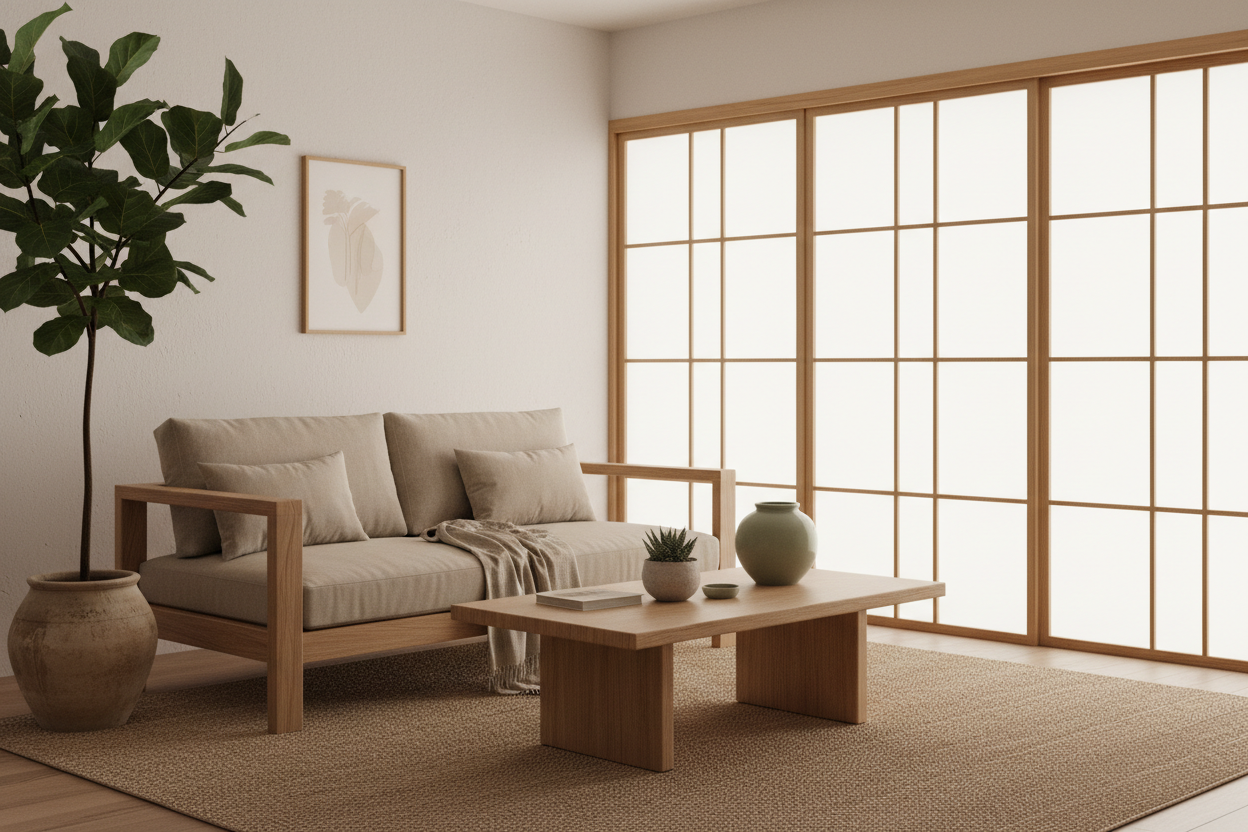
Low furniture — a sofa with short legs, a coffee table close to the floor, soft seating. Not because it's fashionable, but because in both Japanese and Nordic culture the floor plane has a different living value than in Western homes.
No furniture against every wall. An open space at the centre of the room. One strong element — a lamp, a large plant, a handmade piece — and everything else quiet.
A rug in jute, wool or raw cotton. Large enough to hold the main seating.
The bedroom
The low bed is the most iconic Japandi element in the bedroom — and also the most misunderstood. You don't need a Japanese floor-level bed. A bed without a tall headboard, with a clean natural wood frame, set lower than Western standards — that's enough.
Natural linen bedding — unironed, in neutral or warm white tones. This is the simplest and most effective single change you can make to get closer to the style without renovating anything.
Nothing on the bedside table except what you actually need. A book. A lamp. A glass of water. The bedside table is not a storage unit.
The bathroom
The Japandi bathroom often works best because the limited space naturally forces you to choose. Few things, chosen well.
Stone or concrete-effect porcelain — matte, not glossy. Matte black or brushed brass taps. A handmade ceramic piece or two on the vanity shelf. A plant.
The single thing that most transforms a bathroom into something Japandi? Removing. Products along the bath edge, bottles in plain sight, towels everywhere. Remove first, then look at what's actually missing.
Why It Works Particularly Well in Small Apartments
This is the part I most want to talk about, because it's where I see the biggest difference in the projects we work on.
Japandi was born for small spaces — even if nobody says so explicitly. Urban Japanese homes are small, functional, essential by necessity. Scandinavian homes are designed to be lived in completely, not to look large.
Brought into a 55–70sqm Italian apartment, the style works because:
- Designed empty space makes the room feel larger
- A neutral, coherent palette eliminates visual fragmentation
- Low furniture visually raises the ceiling
- Natural materials add warmth without adding bulk
- Soft lighting expands perceived space
It's not about imitating an aesthetic. It's about applying design principles that work regardless of square footage.
If you have a small apartment and want to understand how to apply these principles to your specific space, at Restylit we always start from your floor plan and photos — and build the project around what you actually have, not an ideal apartment. Book a free 15-minute call →
The Most Common Mistake: Confusing Japandi with Minimalism
Japandi is not minimalism. It's actually the opposite of minimalism in the sense that empty space is not the goal.
Minimalism eliminates. Japandi selects.
In a Japandi space there's a ceramic with a visible imperfection, a plant, a linen blanket left on the sofa, a few books. It's not empty — it's full of chosen things. The difference is that everything is there because someone decided it should be. Not out of habit, not by accident.
This is the hardest part to replicate without a project. Because selection requires an overall vision you don't have when you're buying piece by piece.
FAQ
Can you do Japandi without renovating? Yes, partly. You can start with textiles (change the bed linen, add a jute rug), with lighting (2700K bulbs, a rice paper lamp), with order (remove what's superfluous). But for a truly coherent result — palette, materials, layout — you need a project. Otherwise you end up with an apartment that has a few neutral elements, not a style.
What's the difference between Japandi and Wabi-sabi? Japandi is an interior design style that incorporates wabi-sabi as one of its philosophical foundations. Wabi-sabi is a broader aesthetic philosophy — it finds beauty in imperfection, transience and the natural. Japandi uses it as a lens, alongside Scandinavian hygge, to create specific living spaces.
Is Japandi suitable for families with children? More than you'd think. Natural materials are often more durable and easier to maintain than synthetic ones. Solid wood can be sanded, ceramics age well, linen washes. And a tidy space with fewer objects is genuinely easier to keep in order with children around.
How much does it cost to furnish in Japandi style? It depends entirely on the quality of materials you choose. You can do Japandi on a limited budget — hunting for handmade ceramics at markets, buying solid wood furniture secondhand, choosing good linen bedding instead of spending on decorative objects. Or you can spend a lot, on signed design pieces. The style doesn't require a high budget — it requires conscious choices.
Japandi and plants: how many and which ones? Plants in Japandi make sense, but not in quantity. One large, well-chosen plant is worth more than ten small ones. The forms most consistent with the style are simple and organic — Ficus lyrata, Monstera, indoor bamboo, herbs in handmade ceramic pots. No coloured pots, no plastic vases.
If you're thinking about refreshing your home in a Japandi direction and want to understand where to start — materials, layout, palette — at Restylit we do exactly this as part of every consultation. We always start from the real space, not an ideal style.
See how the consultation works →
Restylit is an Italian interior design company, entirely online. We design residential and commercial spaces with photorealistic 3D renderings, shopping lists and technical drawings — across Italy and Europe.


