

Kids' Bedroom Design: How to Create a Space That Grows With Them (and You Won't Regret in Two Years)
How do you design a child's bedroom? By starting from how long that space will last, not from how cute it looks right now. A bedroom designed for a three-year-old is almost always inadequate at seven, and completely wrong at eleven. The choices that age well are those that separate the fixed structure of the space, flooring, wall colour, lighting, from the thematic details that change with age. The structure lasts ten years. The details change in a weekend.
In short: the children's bedroom is one of the domestic spaces where people spend the most and regret the most. Not because the choices are ugly, but because they're made based on the child's current age rather than how that space will need to function over the next ten years. A project that accounts for the child's development costs the same but lasts much longer.
What you'll find in this guide. The design choices that stand the test of time, those that become obsolete quickly, how to organise the space for different age groups, the right materials, lighting, the role of play and study in the same room, and the connection with the unplugged room theme for children in the digital age.
The Problem with Bedrooms Designed for Right Now
A bedroom with a princess or dinosaur theme, walls painted bright pink or electric blue, furniture so low it's designed for a two-year-old: it's beautiful right now. In four years the child will be embarrassed to bring friends over.
This isn't a whim. It's the normal development of a human being who changes tastes, needs and identity far faster than we change the furniture.
The problem isn't choosing the wrong style. It's not separating what needs to last from what can change.
A well-designed children's bedroom has a neutral and flexible structure, onto which thematic details are layered like removable elements. The ceiling stays, the walls stay, the floor stays. The prints, the colour of the duvet, the toys on display: those change every year, and that's perfectly fine.
The Three Phases of a Child's Bedroom: What Each Age Needs
0-5 years: safety and sensory stimulation
At this stage the space needs to be safe above all else. Protected corners, non-toxic materials, nothing that could fall or create hazards. Sensory stimulation is important: vivid but not aggressive colours, materials with different textures, abundant natural light.
What almost everyone overestimates at this stage is the amount of space dedicated to toys. Young children play with less and play better. A clear floor to lie and crawl on is more valuable than ten shelves full of toys.
6-10 years: the study zone becomes central
This is the change that most surprises parents who hadn't planned for it. At six a child needs a place to study, read and draw. If the bedroom doesn't have an adequate study space, homework happens at the kitchen table or in bed, with all the consequences for concentration and posture.
A desk is not optional at six years old. It's the first thing to design for.
11-16 years: privacy and identity
At this point the space changes function almost completely. The bedroom is no longer the place where the child plays under parental supervision: it's the place where the young person builds their own identity, meets friends, studies, needs to be alone.
The needs at this stage are: privacy from the family, space for social life (even just two or three friends sitting together), a study zone separate from the sleeping zone, and the ability to personalise without overhauling the structure.
The Choices That Last Ten Years
The floor
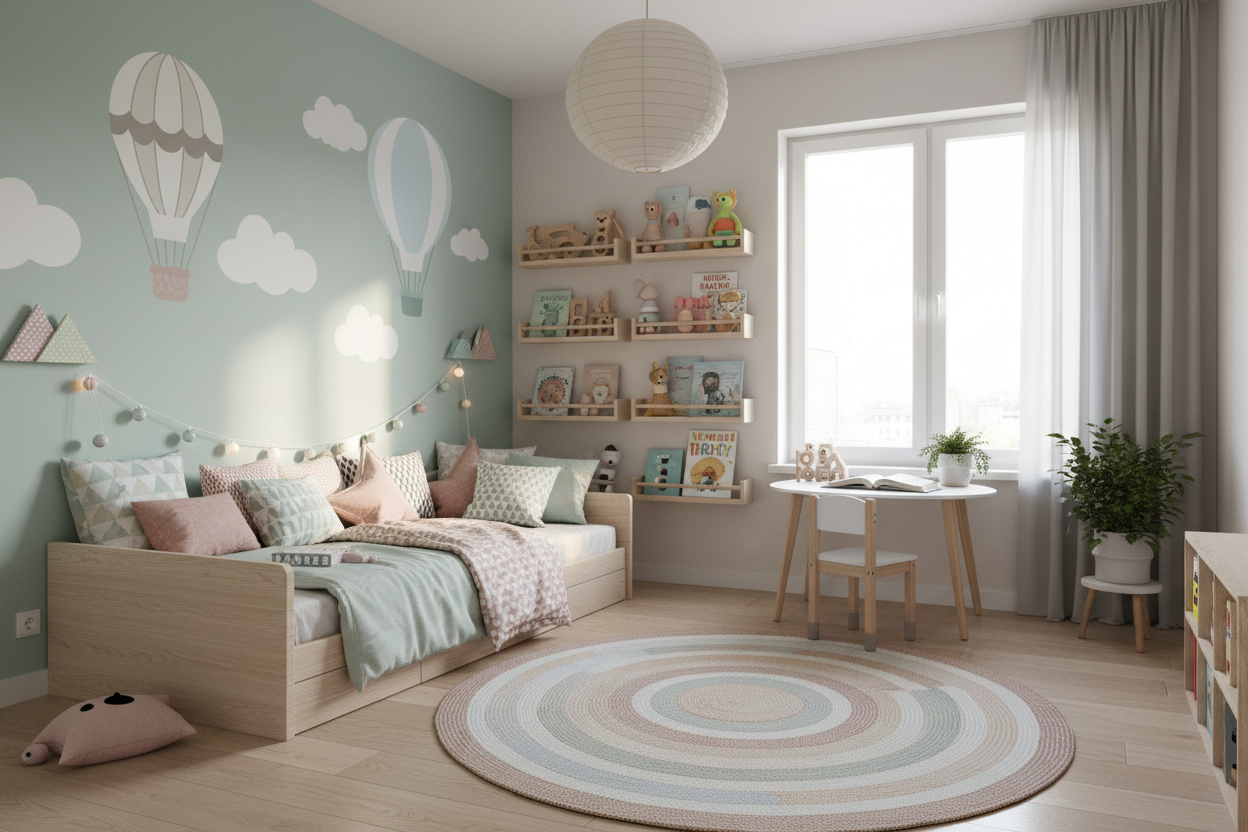
The floor is the choice with the longest lifespan and the highest cost to replace. A light natural wood floor, or a quality wood-effect porcelain, works from early childhood through adolescence without feeling out of place. A coloured carpet or themed vinyl becomes problematic within a few years.
A rug is the right tool for adding warmth and safety in the early years: it changes easily as the child grows.
The wall colour
The single most-regretted choice in children's bedrooms is the colour. Shocking pink walls, electric blue, acid green: beautiful at three, embarrassing at eight.
The wall colour that ages best is a warm neutral with an accent in a muted tone. Warm ivory with a sage green wall, light grey with a terracotta accent. These colours work at every age because they have no specific thematic character. The child's identity is expressed through objects, posters and textiles, all removable and replaceable without any structural work.
The lighting
A child's bedroom needs three distinct types of light, and almost nobody plans for this at the design stage.
General diffused light for when the child is active in the room. Dedicated reading light near the bed or desk. A soft night light for young children who are afraid of the dark.
Three separate circuits, dimmable, at 2700K. Cold lighting in children's bedrooms is one of the most common mistakes: it interferes with sleep and creates an office-like atmosphere that neither encourages play nor rest.
The desk: designed to grow
A height-adjustable desk is the best investment you can make in a child's bedroom. It accompanies the child from six years old through to sixteen without becoming uncomfortable. Many desks designed for young children have fixed heights that are completely inadequate for a thirteen-year-old.
A more affordable alternative: a standard adult desk at a standard height, with an adjustable chair. Children adapt more easily than you'd think, and the desk won't become obsolete.
The Choices That Become Obsolete Quickly
Themed beds
The racing car bed, the princess castle, the knight's fortress. It lasts two or three years before the child no longer wants it. High cost, short lifespan. The best solution is a quality standard bed with a removable canopy or decorative structure that creates the atmosphere without being permanent.
Very low fixed furniture
Furniture designed for young children is unusable for an eleven-year-old. Very tall adult chests of drawers are awkward for a four-year-old. The solution is standard-height furniture with temporary additions: a step stool to reach upper shelves, an internal divider to adapt the drawers.
Saturated and thematic colours
As already mentioned: wall colours should be neutral. Themes are expressed through textiles, posters and objects, all removable and replaceable without structural work.
The Children's Bedroom and the Unplugged Theme
This is the connection we want to make explicitly with the unplugged rooms article, because it directly concerns children's and teenagers' bedrooms.
Children between 6 and 12 spend an average of 4-6 hours a day in front of a screen. Teenagers even more. The bedroom is almost always where this happens, often late in the evening.
A well-designed bedroom supports disconnection without imposing it. This means a few concrete things.
The sleeping zone is visually separated from the study zone where the computer sits. The light in the sleeping zone is warm and dimmable, not cold and fixed. There are no convenient power sockets near the bed. There's an accessible bookshelf near the sleeping area that makes reading the natural alternative to screens.
This isn't censorship. It's design.
Play Space: How Much Is Needed and How to Organise It
The optimal amount of play space in a child's bedroom is often much less than parents imagine.
Children play better with less material and more free space. A study by the University of Toledo found that children with fewer toys available play more creatively and for longer periods than those with many toys at hand.
The design solution that works best is not buying more toy storage: it's reducing the toys present in the room and creating a rotation between what is accessible and what is in storage elsewhere.
The clear floor is the most valuable play space. Everything that takes up floor space, furniture included, reduces the room available for the physical play that young children need.
How Much Does It Cost to Design and Furnish a Child's Bedroom
Costs vary considerably depending on the size of the room and the choices made.
| Item | Indicative cost | Notes |
|---|---|---|
| Bed + quality mattress | €500-1,200 | Invest in the mattress, not the themed bed |
| Height-adjustable desk | €200-600 | Long-term investment |
| Wardrobe | €400-1,500 | Modular is better than fixed |
| Complete lighting | €200-500 | Three separate light points |
| Rug | €80-250 | Easy to change |
| Wall painting | €150-400 | Neutral, not thematic |
| Interior design project | €249-499 | Avoids mistakes that cost far more |
Designing your child's bedroom and want a space that works now and in ten years? The Basic+3D consultation (from €249) includes a photorealistic rendering of the bedroom with the right design choices for the child's current and future age. Book now →
For quick advice on layout, colours and materials, the Basic consultation (€129, 45-minute video call) is the right starting point. Discover the Basic package →
FAQ
At what age should you change a child's bedroom to a teenager's room? There's no precise age, but the most significant change comes around 6-7 years old, when school starts and a study space becomes necessary, and again around 11-12 years old, when the need for privacy and identity increases significantly. A bedroom designed with a neutral and flexible structure adapts to these changes with minimal intervention, without having to start from scratch.
Is a mezzanine bed a good idea in a small child's bedroom? It depends on the age and ceiling height. A mezzanine bed works well from about age 6 onwards, when the child is old enough to climb up and down safely, and up to about 12-14 years old. It requires a ceiling height of at least 2.70 metres to have a liveable study or play area underneath. In teenagers the mezzanine tends to become uncomfortable because it limits the ability to sit up in bed, which is a position they use often.
How do you organise a study zone in a small bedroom? The desk doesn't need to be a large, bulky piece of furniture. A fold-down wall-mounted desk takes up zero space when closed and opens only when needed. A narrow desk (50-60cm deep) with an adjustable chair works well even in spaces under 9sqm. The most important thing is the position: ideally near a window for natural light, and away from the bed to mentally separate study time from rest time.
What colours work in a child's bedroom without being too neutral? The colours that work best are muted natural tones: sage green, soft terracotta, deep teal on a single wall, ochre yellow. Avoid saturated primary colours (bright red, electric blue, canary yellow) which tire quickly and don't grow with the child. A muted colour on one wall, with the other three neutral, gives character to the space without locking it into a permanent theme.
Restylit is an Italian interior design company, entirely online. Photorealistic 3D renderings, shoppable lists, technical drawings for the contractor. Over 500 completed projects, 4.8/5 on Trustpilot.


