

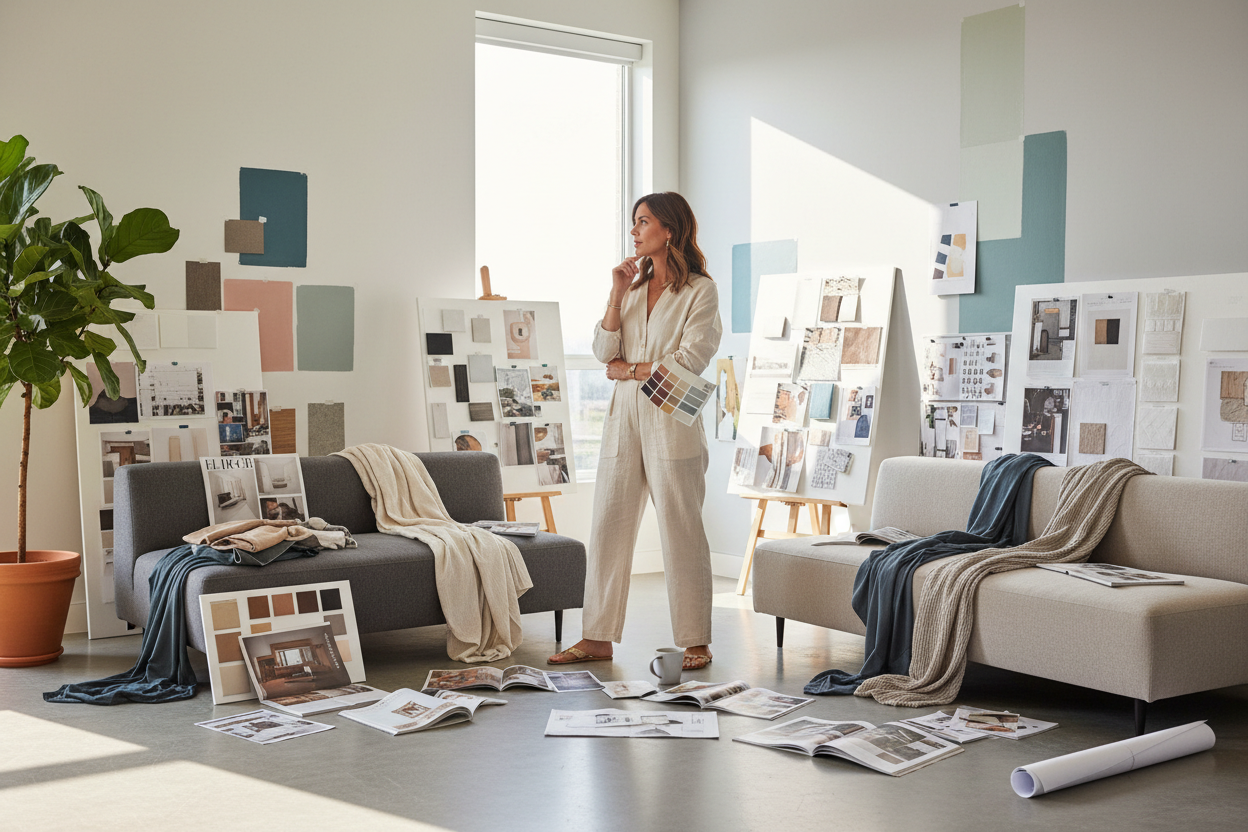
How to Choose the Right Interior Design Style for Your Home
How do you choose the right interior design style? Not by browsing catalogues until something "looks nice", but by starting from how you live and what isn't working in your current space. A style isn't an aesthetic you apply on top of an existing home: it's the visible result of coherent choices about materials, proportions and colours. Those who choose a style starting from an image almost always end up halfway through with something that doesn't quite convince them.
In short: the right interior design style isn't chosen — it's discovered. It emerges from your habits, the materials you find pleasant to the touch, how many objects you need around you to feel at home, and how you want to feel when you walk through the door in the evening.
What you'll find in this guide. The method for identifying your own style from concrete elements, the differences between the most popular styles in 2025, the mistakes made by those who change style every two years, and how Restylit supports this process in the early stages of every project.
Why Choosing a Style Is Harder Than It Looks
Style is the moment where almost everyone gets stuck. Not from a lack of ideas, but from an excess of stimuli. There are dozens of style labels: Scandinavian, japandi, wabi-sabi, industrial, mid-century modern, organic modern, coastal, cottagecore, covecore. New ones appear every year.
The problem isn't finding a style you like. The problem is finding a style that works for how you actually live, that won't tire you after six months, and that can be applied to the specific space you have.
A style chosen for aesthetics but not for lifestyle affinity almost always wears thin quickly. Someone who lives in a chaotic, dynamic way in an ultra-minimal Scandinavian home will struggle. Someone who loves collecting objects with stories in an empty industrial space won't recognise themselves. The style has to reflect who you are, not who you'd like to appear to be.
The Method for Identifying Your Style
These are the questions we ask at the start of every Restylit project to understand which direction to take. They're not questions about aesthetic preferences — they're about habits and feelings.
How do you use your home during the week?
Those who work from home need defined spaces for concentration. Those with young children need surfaces that are durable and easy to clean. Those who regularly host guests need a generous living zone. Those who live alone and spend a lot of time out can make more radical aesthetic choices.
The way you use your home is the first filter for ruling out styles that simply can't work in your specific situation.
Which materials do you like to touch, not just look at?
This question always surprises people, but it's one of the most useful. There's an enormous difference between seeing raw concrete in a photo and living with raw concrete every day — running your hand over it, feeling the texture, accepting the imperfections.
Those who find concrete cold and uncomfortable will never feel at ease in an industrial home, however beautiful the photos look. Those who love the roughness of natural materials won't feel comfortable among the lacquered surfaces of an ultra-contemporary apartment.
How many objects do you need to feel at home?
This is perhaps the most revealing question. Some people feel at ease in spaces with very few elements, where the empty space is part of the design. Others need books, plants, objects with history, things that say something about who they are. Neither is wrong: they're simply incompatible with certain styles.
Someone who needs objects around them will never find a minimal apartment truly comfortable, however beautiful it looks in photos. Someone who feels suffocated by too much will never live well in a maximalist style, however carefully each individual piece is chosen.
How do you want to feel when you come home?
Cosy and protected. Free and airy. Stimulated and inspired. Calm and quiet. This answer is more useful than any aesthetic preference because it points to the emotional function the space needs to fulfil. And from that function, you work back to the style.
The Most Popular Styles in 2025: What They Actually Are
Once you've identified your direction through the questions above, a clear map of the most common styles helps you understand which one comes closest to what you're looking for.
| Style | Key characteristics | Who it works for |
|---|---|---|
| Scandinavian | Functional, natural light, light wood, neutral palette | Those who want visual order and simplicity without coldness |
| Japandi | Japanese and Scandinavian fusion, wabi-sabi, natural materials, designed empty space | Those who want calm and intentionality, few things chosen well |
| Mid-century modern | Organic forms of the 1950s-60s, wood, warm colours, iconic design | Those who love design history and materials with character |
| Organic modern | Clean lines with earthy tones, natural materials, rounded forms | Those who want a contemporary feel grounded in nature |
| Industrial | Concrete, metal, exposed brick, grey and dark palette | Those who want an urban aesthetic and don't need warmth |
| Coastal | Light and airy, natural textures, soft blues and sandy neutrals | Those who want a relaxed, breezy atmosphere |
| Wabi-sabi | Imperfection celebrated, materials that age well, nothing perfect | Those who find beauty in imperfection and authentic materials |
| Contemporary | Fluid and updated, mixes elements from different styles with a common thread | Those who want freedom without rigid rules |
The Mistake of Those Who Change Style Every Two Years
There's a pattern we see repeat itself with many clients who come to us: they've already renovated or furnished once, but after two or three years the result no longer convinces them and they want to change everything.
Almost always the problem wasn't the style chosen itself, but the way it was applied. A style copied from a magazine without understanding its principles becomes dated quickly because it follows the trend of the moment instead of reflecting who lives in that space.
A style applied with coherence and depth, starting from who you are and how you live, doesn't tire. The wabi-sabi of someone who genuinely finds beauty in imperfection will last twenty years. The wabi-sabi chosen because it was trending in 2023 will already feel dated by 2026.
The difference is the same as wearing something that reflects who you are versus wearing something because it's fashionable.
Mixed Styles: When It Works and When It Doesn't
Almost nobody lives in a home of pure style. Most homes contain elements of different styles, accumulated over time or chosen with different logics.
Mixed styles work when there's a unifying element that holds everything together. It can be the colour palette, the materials, the proportions, or the number of objects. Without that unifying element, the mix simply becomes disorganised.
The simplest way to make a mixed style work is to choose a material common thread. If all the materials are natural and matte, a mix of styles creates variety without fragmentation. If the palette is narrow and coherent, elements from different styles coexist without competing.
How Restylit Helps You Find the Right Direction
The first part of every Restylit project is not technical but exploratory. Before talking about materials, colours or renderings, we understand who lives in that space and how they live in it.
The questions we ask, the images we invite clients to share, the problems we ask them to describe — everything serves to build a precise profile of what will work in that specific context. Not a catalogue style, but a tailored direction.
The 3D rendering we then produce shows concretely how that direction translates into the real space, with the actual measurements, light and materials of that apartment. It's the most effective way to understand whether the chosen direction is truly the right one before buying anything.
Can't work out which style suits you, or worried about choosing something that will tire quickly? The Basic+3D consultation (from €249) always starts from a conversation about how you live in your space, not from a catalogue of styles. Book now →
For a first quick conversation with an architect about your stylistic direction, the Basic consultation (€129, 45-minute video call) is the right starting point. Discover the Basic package →
FAQ
How do you find out which interior design style suits you? You start from your habits, not your aesthetic preferences. The most useful questions are: how do I use my home during the week, which materials do I like to touch, how many objects do I need to feel at home, and how do I want to feel when I come home in the evening. The answers to these questions guide you towards a style that works long term, not just in photos.
How many styles can you mix in a home? There's no precise number, but there's one necessary condition: there must be an explicit common thread holding the different elements together. It can be the colour palette, the materials or the proportions. Without that common thread, a mix of styles becomes visually chaotic even when each individual piece is of quality.
Can your interior design style change over time? Yes, but a style born from who you are evolves naturally and gradually, not through complete breaks. Those who choose a style from genuine affinity update it over time by adding elements or changing details, without needing to start from scratch every three years. Those who choose a style for its trendiness find it dated as soon as the trend shifts.
What's the difference between Scandinavian style and japandi? Scandinavian style prioritises functionality, natural light, light wood and a neutral palette with coloured accents. Japandi fuses Japanese minimalism, with its wabi-sabi and attention to imperfection, with Scandinavian comfort. Japandi tends to have less colour, more visual silence and greater attention to the quality of individual materials compared to classic Scandinavian style.
Restylit is an Italian interior design company, entirely online. Photorealistic 3D renderings, shoppable lists, technical drawings for the contractor. Over 500 completed projects, 4.8/5.


