

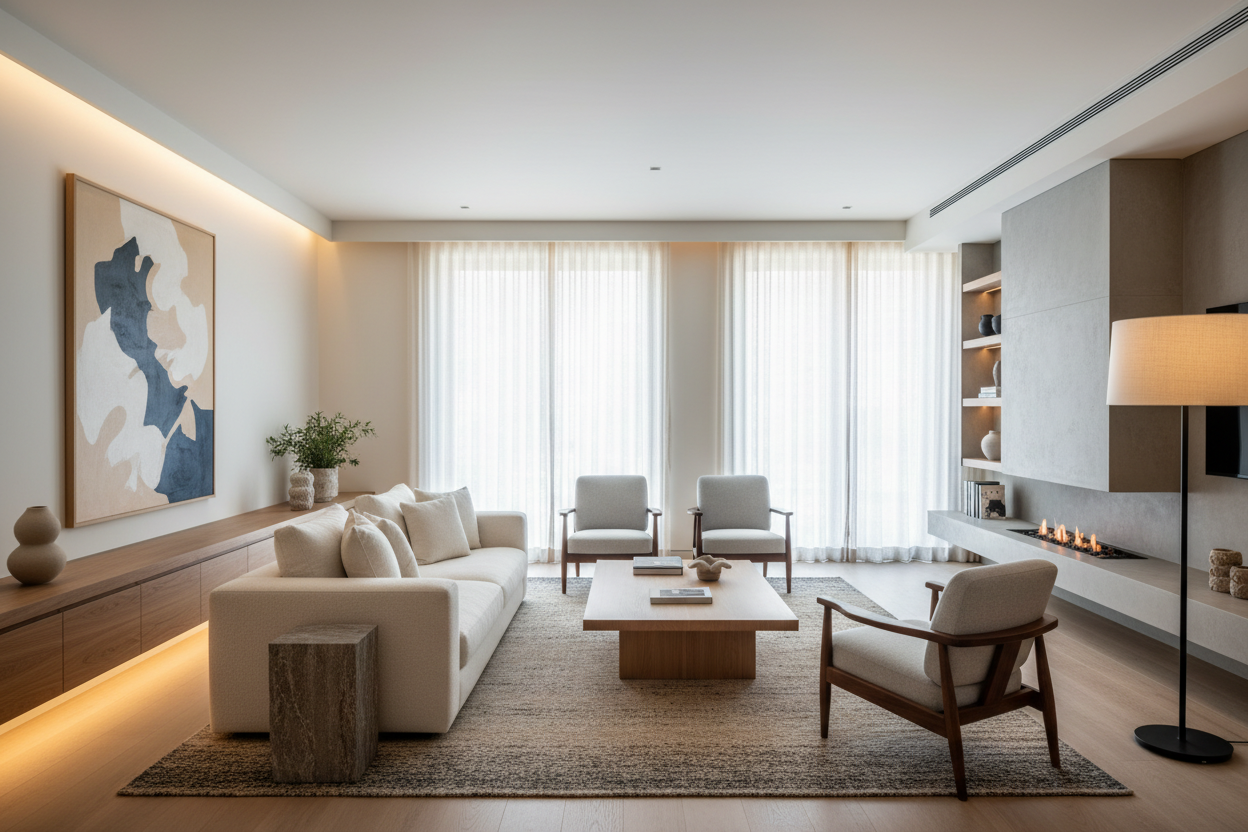
How to Furnish a Modern Home: Styles, Materials and the Choices That Last
How do you furnish a home in a modern style? Modern style in interior design is not a catalogue aesthetic but a specific method. Few elements, chosen well, in quality materials, with nothing superfluous. A modern home works because every choice has a reason: the piece of furniture is where it is because it's needed, the light is where it is because it illuminates in the right way, the colour is that one because it speaks to the natural light of the room.
In short: furnishing modern means choosing fewer things and choosing them better. It's not a style you buy but a result you design.
What you'll find in this guide. The difference between modern, contemporary and minimal, the materials that hold up over time, the basic rules for a coherent result, and the most common mistakes made by those who try to replicate a style without a project.
Modern, Contemporary, Minimal: The Differences That Matter
These three terms are used as synonyms. They're not.
Modern refers to a specific movement: the Modernism of the twentieth century, with its principles of function before form, clean lines and the absence of superfluous decoration. Mies van der Rohe, Le Corbusier. "Less is more" in the most literal sense.
Contemporary describes instead what we do today. It's fluid, it changes with the decades. In 2025, contemporary mixes natural materials, organic forms and deep colours. It's not a synonym for cold or clinical.
Minimal is a more radical aesthetic position, with space reduced to the essential, every element in its place and nothing left to chance. It requires a great deal of order to work.
In most cases, when people say "I want something modern" they mean: clean, coherent, not dated, with quality materials. That's a good working definition and it's the one we work with.
The Materials That Define Modern Style
Modern style is recognisable by its materials before its forms. These are the ones that work.
| Material | Where it works | What to avoid |
|---|---|---|
| Natural wood | Floors, structural furniture, details | Wood-effect laminate in cheap versions |
| Matte metal (black, brass) | Handles, furniture legs, lighting | Shiny chrome: it ages badly |
| Concrete or concrete-effect porcelain | Floors, bathroom, kitchen | Glossy surfaces: they collect fingerprints |
| Glass | Tables, internal doors, shelving | Too much glass creates an office effect |
| Natural textiles (linen, cotton, wool) | Curtains, cushions, rugs | Shiny polyester: it breaks the coherence |
| Marble or marble-effect | Kitchen worktop, bathroom, details | Marble everywhere: it becomes heavy |
The general rule: materials with visible texture, matte or satin surfaces, a neutral palette with one or two accents. Gloss is almost always the enemy of modern style.
The Basic Rules for a Coherent Result
1. The palette before the furniture
In a modern home the colour palette is narrow and coherent. Three tones at most: a dominant neutral (warm white, light grey, sandy beige), a tone of depth (olive green, teal, charcoal) and an accent used sparingly (brass, terracotta, rust).
The palette is decided before buying any piece of furniture.
2. Every room has one protagonist element
The sofa, the lamp, the bookcase. One strong piece and everything else in service of that. When every element competes for attention, the result is confusion even when each piece is beautiful on its own.
3. Lines are clean
Clean doesn't mean empty. It means that the lines of the furniture have no superfluous decoration, that the floor grout lines are narrow, that the handles are integrated or minimalist. But there can be books, plants, objects with a history. What matters is that everything has its place.
4. Lighting is designed, not added
In modern homes, lighting is not a final detail but part of the project. Diffused general light, functional light where needed, atmospheric light in the corners. All at 2700K. A single central ceiling light is never enough on its own.
5. The floor is continuous
A uniform floor, meaning the same material in the same direction, makes the space feel larger and more intentional. Changes of material create visual boundaries and fragment the space. In the projects we follow, one of the most frequent pieces of advice is exactly this: keep the floor continuous between the living room, corridor and kitchen.
The Most Common Mistakes
Buying "modern" piece by piece without a project. This is the main mistake. Each piece of furniture seems right on its own but together they don't work: incoherent palette, different scales, styles that mix without logic.
Using too much pure white. Pure cold white, the kind you find on fresh plasterboard, becomes metallic and oppressive under artificial light. Warm ivory or light warm grey works much better.
Eliminating everything and calling it minimal. An empty space is not minimal but unfinished! Authentic minimal has very few elements but each one is chosen with care and precision.
Ignoring the lighting. A home with modern furniture and fluorescent lights is not modern. Light is the invisible material that defines everything else.
Mixing too many styles in search of "eclecticism". Eclecticism works when there's a project holding it together. Without a project it's simply incoherence.
How Much Does Furnishing a Modern Home Cost
The honest answer: it depends far more on the choices than on the square footage.
A modern home doesn't require a high budget but a well-allocated one. A quality sofa, a continuous floor, the right light and a colour chosen with method produce a better result than many mediocre pieces put together.
The highest cost in modern furnishing is not the furniture. It's the mistakes: the piece bought and then replaced, the colour repainted, the floor that doesn't suit the light. With an interior design project, these mistakes are eliminated before you even begin.
How Restylit Helps You Create a Modern Home
At Restylit we often work on projects that start with "I want something modern but I don't know where to begin." It's one of the most common requests. And almost always the answer starts from the same place: understanding the natural light of the room, defining the palette, establishing which element will be the protagonist.
The photorealistic 3D rendering we produce shows exactly how the space will look, with those materials, that light, those pieces of furniture, before anything is purchased. It's the most effective way to avoid regrets about choices that last twenty years.
Furnishing a modern home and want to see the result before you start? The Basic+3D consultation starts from €249 and includes a moodboard, photorealistic renderings and a shopping list with purchasable products. Book now →
Looking for quick advice on colours and materials? The Basic consultation (€129, 45-minute video call) is designed for exactly that. Discover the Basic package →
FAQ
What is modern style in interior design? Modern style in interior design refers to an approach that prioritises function over decoration, clean lines, quality materials and visual coherence. It's not a specific aesthetic but a method: every element has a reason to be there. Typical materials are natural wood, matte metal, concrete, natural textiles and glass.
What's the difference between modern and contemporary in furnishing? Modern refers to the Modernism of the twentieth century, with function before form and the absence of superfluous decoration. Contemporary describes the aesthetic of the present moment, which in 2025-2026 mixes natural materials, organic forms and deep colours. The two terms are often used as synonyms but they're not.
What colours are used in a modern home? The modern palette is narrow: a dominant neutral (warm white, light grey, beige), a tone of depth (olive green, teal, charcoal) and an accent used sparingly (brass, terracotta, rust). Pure cold white on its own tends to feel clinical: warm whites work better.
Can you furnish in a modern style on a limited budget? Yes, but it requires more precision in the choices. On a limited budget it makes sense to concentrate the spending on the protagonist piece of furniture in each room (sofa, bed, main lamp) and reduce everything else to a minimum. Wall colour and the right light cost little and do a great deal.
Restylit is an Italian interior design company, entirely online. Photorealistic 3D renderings, shoppable lists, technical drawings for the contractor. Over 500 completed projects, 4.8/5.


