

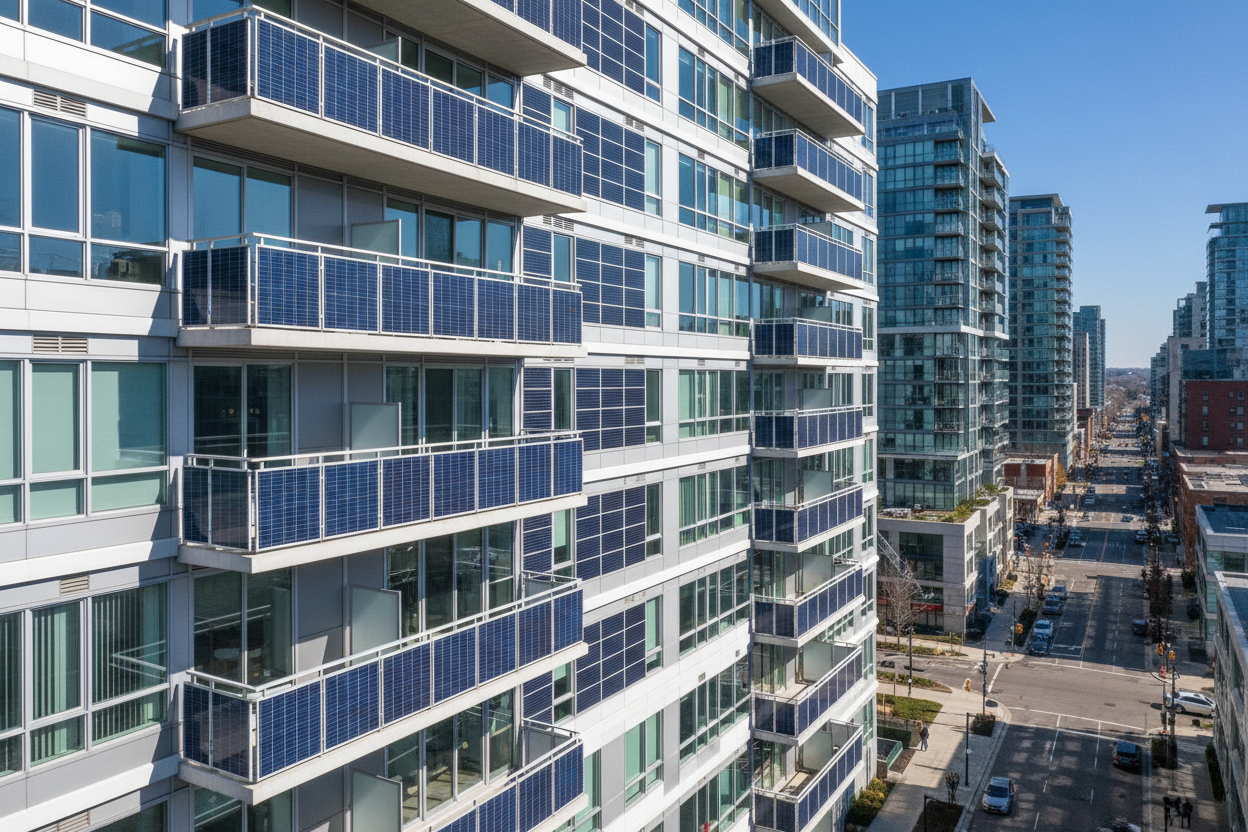
Balcony Solar Panels: They're Not as Ugly as You Think (and They Actually Save You Money)
By Mattea, co-founder and Interior Architect — Restylit
What are balcony solar panels? They're a mini solar installation — one or two photovoltaic panels mounted on a balcony, terrace or apartment railing — that produces electricity for direct use at home. A standard 800W kit costs between €350 and €850, requires no planning permission, no approval from the residents' association, and with the 50% renovation bonus the net cost halves. Estimated annual savings range from €250 to €440 depending on location and consumption patterns.
It's one of the most searched home topics of 2025. And one where the main objection is always the same: "Sure, but it's ugly."
Let's talk about that.
The Aesthetic Problem — Addressed Directly
I'll say something that most solar panel articles never say: the aesthetic objection is legitimate.
A black solar panel propped against a balcony railing, tilted at an angle, with cables running down the wall — that's not a design element. It's a functional object that, if poorly positioned, can genuinely compromise the look of a terrace and a building facade.
But "can be ugly" doesn't mean "is necessarily ugly." It means it requires a little thought — like almost everything in space design.
The truth is that the latest balcony panels are far more considered aesthetically than those of ten years ago. They're slim, dark, with clean profiles. On a balcony with a black or anthracite railing, well integrated, they're barely noticeable. On a balcony with planters, wood and natural materials, they can become part of a coherent composition.
The problem isn't the panel. It's how it's positioned.
How It Works — The Technical Part Made Simple
Before talking about aesthetic integration, it's worth understanding what you're actually installing.
The two types of system
Plug & play (up to 350W) — a single panel that connects directly to a dedicated socket. No technician needed. The simplest format, one you can order online and install yourself over a weekend. Cost: €350–600.
Mini installation (up to 800W) — one or two panels with a micro-inverter. Requires installation by a qualified technician and notification to the local grid operator. No planning permission, no residents' association approval needed. Cost: €650–850 before incentives.
How much does it actually produce
An 800W system produces roughly 950–1,200 kWh per year depending on location — less in northern regions, more in the south. With energy costs around €0.37/kWh in 2025, the potential annual saving is €350–440. But there's an important variable: self-consumption.
The energy produced during the day needs to be consumed in real time — what you don't use immediately isn't stored (unless you have a battery). If you're home during the day, your savings are maximised. If you're at work from 9 to 6, some of the energy produced during peak hours gets "donated" to the grid.
How quickly do you recoup the investment?
With an energy cost of €0.37/kWh and 65% self-consumption, the real saving in bills is around €252 per year for an 800W system without a battery. With the 50% renovation bonus, the net cost of the system drops to €325–425. Time to break even: 1.5–2 years. Not bad.
The 2025 Rules: What You Can Do Without Asking Anyone's Permission
This is the part that worries people most — and it's actually much simpler than it looks.
No residents' association approval needed.
Article 1122-bis of the Italian Civil Code establishes that residents can install photovoltaic systems for personal use on their own property without assembly consent, provided the installation doesn't compromise structural stability or significantly alter the building's architectural character. A February 2026 ruling by the Monza Tribunal further reinforced this — the condominium cannot block the installation.
It's good practice to notify the building manager in writing, but it's a notice — not a request for permission.
No planning permission needed.
Systems up to 800W fall under simplified connection procedures introduced by ARERA, with no planning permits required as long as they don't alter the building's structure or aesthetics. They're classified as free construction works.
What you actually need to do:
For plug & play (up to 350W): nothing bureaucratic. Install and use.
For mini systems (up to 800W): a single notification to the local grid operator. Done online, takes 15 minutes.
2025 Incentives — What You Need to Know
50% Renovation Bonus
Balcony solar panels fall under the Renovation Bonus with a 50% IRPEF tax deduction on primary residences and 36% on other properties, up to €96,000 per unit, spread over 10 years. In practice: if you spend €800, you recover €400 over 10 years (€40/year off your tax return). Net effective cost: €400.
Reduced VAT at 10%
Purchase and installation benefit from 10% VAT instead of 22%. An automatic saving.
How to access the bonus: Payment by dedicated bank transfer (with the required legal reference), keep the invoices, declare on your tax return. Nothing complicated — your accountant can handle it in five minutes.
The Design Side: How to Integrate It Without Ruining the Terrace
This is the part I most want to address — and that almost no solar panel article ever touches.
Position is everything.
A panel tilted randomly on a railing, pointed south but positioned at an odd angle with visible cables running down the wall — that's the "ugly" version everyone imagines. And it's avoidable.
The best positions from an aesthetic standpoint:
On the parapet or railing — with dedicated brackets that keep the panel vertical or slightly angled, clean in profile. If the railing is dark, the panel integrates almost completely.
As a pergola or canopy covering — if the terrace already has a structure, panels become part of the roof. This is the most aesthetically successful solution and also the one that maximises output.
On a ground-mounted tilted frame — in a corner of the terrace, as a standalone element. Works well if the terrace is large enough to incorporate it as part of the overall composition.
The cables — the real aesthetic problem.
The cable connecting the panel to the indoor socket is what, poorly managed, ruins everything. The solution is simple: wall-mounted cable channels in the same colour as the wall or floor, or painted plastic conduit. Costs a few euros and changes the whole visual result.
Panel colour and finish.
Modern panels are almost all matte black or gloss black. On a terrace with dark elements, plants, natural wood or metal — they integrate well. On a bright white terrace with light-coloured paving, they stand out more. In that case it's worth considering a railing-mounted position rather than floor level.
The panel as part of the project.
What I like most about balcony solar from a design perspective is this: if you think of it as part of the terrace project rather than an afterthought, everything changes. It's not an ugly box stuck on later — it's an element that produces energy, has its own logic, and is positioned where it needs to be. Exactly like any other functional element in a well-designed space.
When It's Not Worth It — The Honest Answer
I don't want to write the article that only says positive things. There are cases where balcony solar simply doesn't make sense.
North-facing balcony. Orientation is everything. A north-facing balcony produces very little — often 40–50% less than a south-facing one. Break-even times stretch dramatically.
Balcony shaded by other buildings. If direct sunlight only reaches you for a few hours a day, production is limited. It's worth making a realistic estimate before buying.
If you're rarely home during the day. Without a battery, energy produced that you don't consume in real time is fed to the grid for free. If you work outside all day and come home in the evening, effective self-consumption will be low and savings smaller than expected.
If your building has architectural heritage restrictions. Historic buildings, protected zones, facades with specific aesthetic requirements — in these cases the "must not alter the architectural character" clause of Article 1122-bis can be interpreted more strictly. Worth checking before you install.
Storage Battery: Is It Worth It?
A battery solves the self-consumption problem — it stores energy produced during the day and releases it in the evening when you need it.
With a LiFePO4 battery, self-consumption rises from 60–70% to 80–95%. The additional cost is around €500–900, but the break-even time remains competitive, often between 4 and 6 years.
Worth it if your consumption is concentrated in the evening — air conditioning, washing machine, cooking, television. Less worth it if you're home during the day and already consuming most of the produced energy in real time.
The Question Everyone Asks: How Much Do I Actually Save?
Let's do the honest maths, without excessive optimism.
Typical scenario — apartment in Milan, south-facing balcony, family that works outside during the day:
- 800W system, no battery
- Estimated annual production: ~950 kWh
- Realistic self-consumption: 60% = 570 kWh self-consumed
- Annual saving: 570 × €0.37 = €211
- System cost after 50% bonus: ~€375
- Break-even time: under 2 years
Optimal scenario — apartment in Rome, south-facing terrace, person working from home:
- 800W system, no battery
- Estimated annual production: ~1,200 kWh
- Realistic self-consumption: 80% = 960 kWh self-consumed
- Annual saving: 960 × €0.37 = €355
- System cost after 50% bonus: ~€375
- Break-even time: just over 1 year
After breaking even, the system continues producing energy for 20+ years. That's a return that's hard to find elsewhere.
FAQ
Can I install balcony solar without telling anyone? For plug & play systems up to 350W, technically yes. For mini systems up to 800W, you need to notify the local grid operator (a simple online procedure) and it's good practice to inform the building manager, even though it's not an approval process.
Does balcony solar increase property value? Marginally and difficult to quantify for balcony-scale systems. The main benefit is the immediate energy saving, not property appreciation.
How many panels can I put on my balcony? Depends on available space and the power limit — 800W total for the simplified procedure. With 400W panels, that's two. With 350W panels, you can get close to the limit with slightly fewer.
If I move, can I take the panels with me? Yes — that's one of the advantages of the balcony format versus rooftop panels. They're easily dismounted and reinstalled in the new apartment.
Do balcony solar panels work in winter? Yes, but with reduced output. The worst months are December, January and February when performance drops 10–30% due to shorter daylight hours. The annual balance remains positive.
It's not a solution for everyone and it doesn't solve everything. But for those with a well-exposed balcony, the possibility of recouping an investment in under two years on a system that lasts twenty is hard to ignore. And if you integrate it properly into the terrace design — rather than adding it as an afterthought — it can become a coherent part of a well-considered outdoor space.
Restylit is an Italian interior design company, entirely online. We design residential and commercial spaces with photorealistic 3D renderings, shopping lists and technical drawings — across Italy and Europe.


