

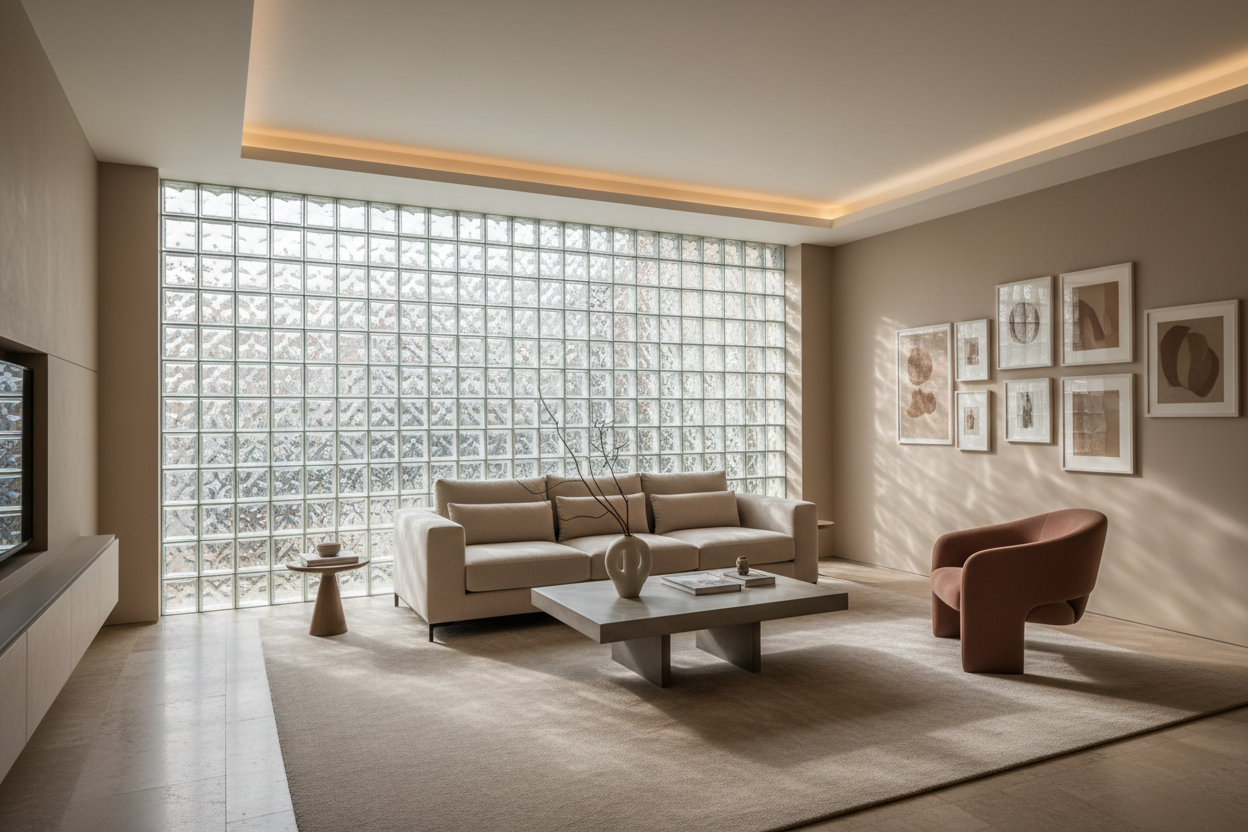
Glass Blocks Are Back: Why the Material You Hated in the 80s Has Become a Star of Contemporary Interiors
Why are glass blocks coming back into fashion? Because they answer three needs that dominate residential design right now: natural light, privacy, and spatial separation without heavy masonry. After a long period of association with the kitsch bathrooms of the 1980s, glass blocks have cleaned up aesthetically and are returning to contemporary projects in a completely different way — more restrained, more architectural, more intentional.
This isn't nostalgia. It's function.
First of All: What Are We Actually Talking About
Glass block, glass brick, vetromattone — different names for the same material. A pressed glass module, hollow on the inside, that allows light to pass through without allowing direct vision.
The standard module is square, 19×19cm, about 8cm thick. Inside there's an air cavity that contributes to thermal insulation. The surface can be smooth, rippled, satin, or matte. The classic colour is that transparent blue-green everyone remembers, but today there are neutral, white, black and satin finishes that have nothing to do with that aesthetic.
Understanding the difference between these finishes is where everything changes:
Classic transparent — allows a lot of light through and you can see the silhouette of whoever is on the other side. This is the 80s version. I almost never recommend it.
Satin or matte — diffuses light without showing anything. This is what's used now. Creates beautiful luminous effects with no voyeuristic component.
Coloured — exists, but needs to be used with considerable care. Green, blue, pink — they can work in specific contexts, but require a precise project built around them.
The History: How an Industrial Material Became an Icon, Then Disappeared
Glass block was born in the 1920s — not for homes, but for factories. It was used to bring light into industrial buildings without opening large windows. Resistant, waterproof, translucent.
The first house to use it seriously was the Maison de Verre in Paris, designed in 1932 by Pierre Chareau. A facade made entirely of glass blocks, capable of filtering light during the day and glowing from within at night. At the time, Saint-Gobain — who manufactured the blocks — couldn't even guarantee the material would withstand weather. Nearly a century later, that house still stands, perfectly intact.
Then came the 1980s. Glass block entered mass-market private homes — bathrooms, showers, partition walls. But it was used badly. Transparent, with coarse texture, in questionable colour combinations. It became synonymous with apartments that needed gutting.
And there it stayed, for thirty years.
What's happening now is different. As architect Thomas Karsten from Berlin put it in a recent interview: glass block is an ancient material with a futuristic footprint — it works today exactly as it did a hundred years ago. We just use it better now.
Why It's Coming Back Now — The Real Reasons
This isn't a random trend. There are precise reasons why glass block has returned to contemporary projects.
1. The light problem in modern apartments
Urban homes have become smaller and more compressed. Many apartments have rooms with no windows, dark corridors, bathrooms with no natural light. Glass block solves this elegantly — it brings natural light from one room to another without opening up the floor plan.
A glass block wall between the bathroom and the bedroom, or between the corridor and the living room, completely transforms how both spaces feel. It's not a decorative detail. It's a design decision that changes how you live in the apartment.
2. The reaction against sterile minimalism
After a decade of white walls, smooth surfaces and spaces that looked like showrooms, people are looking for materials with character. Glass block has texture, depth, a luminous quality that no other material can replicate. It creates shadows and reflections that shift with the time of day. It's tactile. It has presence.
Someone on Twitter a few years ago put it well: we've really lost the plot with minimalism. It doesn't need to be ugly greige and tearing up beautiful old houses to make things look sleek and lifeless. That post had tens of thousands of shares. It says something real about where collective taste is heading.
3. The relatively low cost compared to other special materials
At a time when construction costs have exploded, glass block is still accessible. It costs far less than structural glazing, less than a steel and glass partition, less than almost any architectural alternative that delivers similar light effects. It's become an intelligent way to create something visually strong without spending a fortune.
4. Improved technical performance
Modern glass blocks are not the same as the ones from the 1980s. Dry-fit systems (without mortar) make installation more precise and the final result far cleaner. Thermal and acoustic performance has improved. And the range of finishes available is completely different from thirty years ago.
How to Use Glass Block Well Today — and Where It Doesn't Work
This is the part I care most about, because I see a lot of projects using it badly.
Where it works well:
Partition walls between rooms — by far the most effective use. A non-load-bearing wall replaced with glass blocks transforms two dark rooms into two bright ones. In apartments with complex floor plans or corridors with no visual outlet, it's often the smartest solution available.
Shower enclosures and bathroom walls — the original context, and still one of the best today. But with satin or matte finishes, not transparent. The result is a spa-like atmosphere — soft, diffused light, complete privacy.
Entrance-to-living separation — in apartments without an entrance hall, a small glass block wall between the front door and the living area creates a transition without closing the space. Even just a few rows of blocks work — you don't need a full wall.
Kitchen backsplash — one or two rows of glass blocks above the worktop, in place of the traditional tile splashback, creates an interesting effect in kitchens that look onto courtyards or that need additional light.
Mezzanines and stairwells — glass block walls around a staircase bring light down to the lower floors and create visual continuity between levels without fully opening the space.
Where it doesn't work:
As a decorative element on a solid wall — a panel of glass blocks on a wall that doesn't lead anywhere and doesn't divide anything is purely decorative. And as decoration, it rarely justifies the complexity of installation.
Paired with very warm, soft styles — glass block has an industrial, modernist soul. It works well with concrete, metal, dark wood, white. It doesn't work as naturally surrounded by floral curtains and Provençal furniture.
With classic transparent finishes — said it above, worth repeating. Transparent glass block at full view is the 1980s version. Today you use satin or matte, almost always.
In excessive quantities — using it everywhere is the worst mistake you can make. It's a material that works as a standout element. One wall, two at most. Not the whole apartment.
The Projects That Convinced Us
One of the projects that has stayed with me is by the studio Papundekl Architects, working on a poorly lit 1970s apartment. Instead of demolishing walls, they created new partitions entirely in glass block — with curved blocks that follow the line of the corridor and wrap around the bathroom. Light literally travels across the whole apartment. The walls aren't dividing — they're filtering.
This is the approach that makes glass block interesting today. Not as a cladding, not as decoration. As an architectural element that builds space through light.
The Restylit Perspective: When We Recommend It and When We Don't
In the projects we follow, glass block comes up in conversation every time there's a light problem to solve without knocking down walls.
We often recommend it in apartments with:
- Bathrooms or corridors without natural light
- Open-plan spaces that need dividing without losing brightness
- Entrances without a hallway
- Renovations where a strong architectural element is wanted without excessive cost
We don't recommend it when:
- The problem is aesthetic rather than functional — there are better materials
- The apartment's style is very warm and organic (Japandi, wabi-sabi) — glass block has a different soul
- The budget is very tight and there are more urgent priorities — it's always a special element, not a base material
The thing we always say: glass block used well doesn't read as glass block. It reads as light. If the first thing you notice when you walk into a room is "ah, they've used glass block," it's probably been overdone. If the first thing you think is "what beautiful light this bathroom has," the work is done right.
If you're renovating and wondering whether glass block might solve a problem in your apartment, that's exactly the kind of question we work through in our consultations. You understand the problem first, then choose the material — never the other way around. Book a free 15-minute call →
FAQ
How much does it cost to install a glass block wall? Costs vary significantly depending on size and installation type. A roughly 2sqm wall in standard glass blocks with traditional mortar installation can cost between €400 and €800 in labour alone, plus materials (€30–60 per sqm). Dry-fit systems are more expensive but give a cleaner final result. It's a modest investment compared to other architectural solutions with similar effects.
Does glass block provide acoustic insulation? Better than you'd expect. The thickness of the blocks and the internal air cavity provide acoustic insulation superior to a single plasterboard wall. It doesn't replace a properly insulated traditional wall, but for internal partitions it's often a workable compromise.
Can glass block be used in a rented apartment renovation? In principle yes, but it needs to be agreed with the landlord — it constitutes a structural modification. Many rental contracts require written authorisation for structural changes.
What's the difference between glass block and glass brick? They're the same thing. In Italian, vetrocemento describes the construction technique (glass elements assembled with mortar), vetromattone refers to the individual module. In practice both terms refer to the same product.
Can glass block be used on exteriors? Yes — that was its original use. Facades, skylights, ventilated external walls. It requires specific external installation systems and needs to be correctly specified to handle thermal stress. For exterior uses, professional consultation is always necessary.
How do you clean it? This is the material's weak point. The irregular surface of glass blocks collects dirt and limescale, especially in bathrooms. Satin finishes are harder to clean than smooth ones. In bathrooms, regular cleaning with specific glass products is necessary — don't let limescale build up.
Glass block is one of those materials that divides opinion — those who love it can't imagine their apartment without it, those who hate it still think of their grandmother's bathroom. The truth is that used well, in the right place, it's one of the few materials genuinely capable of transforming how light enters an apartment. And light, as we keep saying, is the most important material you have.
Restylit is an Italian interior design company, entirely online. We design residential and commercial spaces with photorealistic 3D renderings, shopping lists and technical drawings — across Italy and Europe.


