

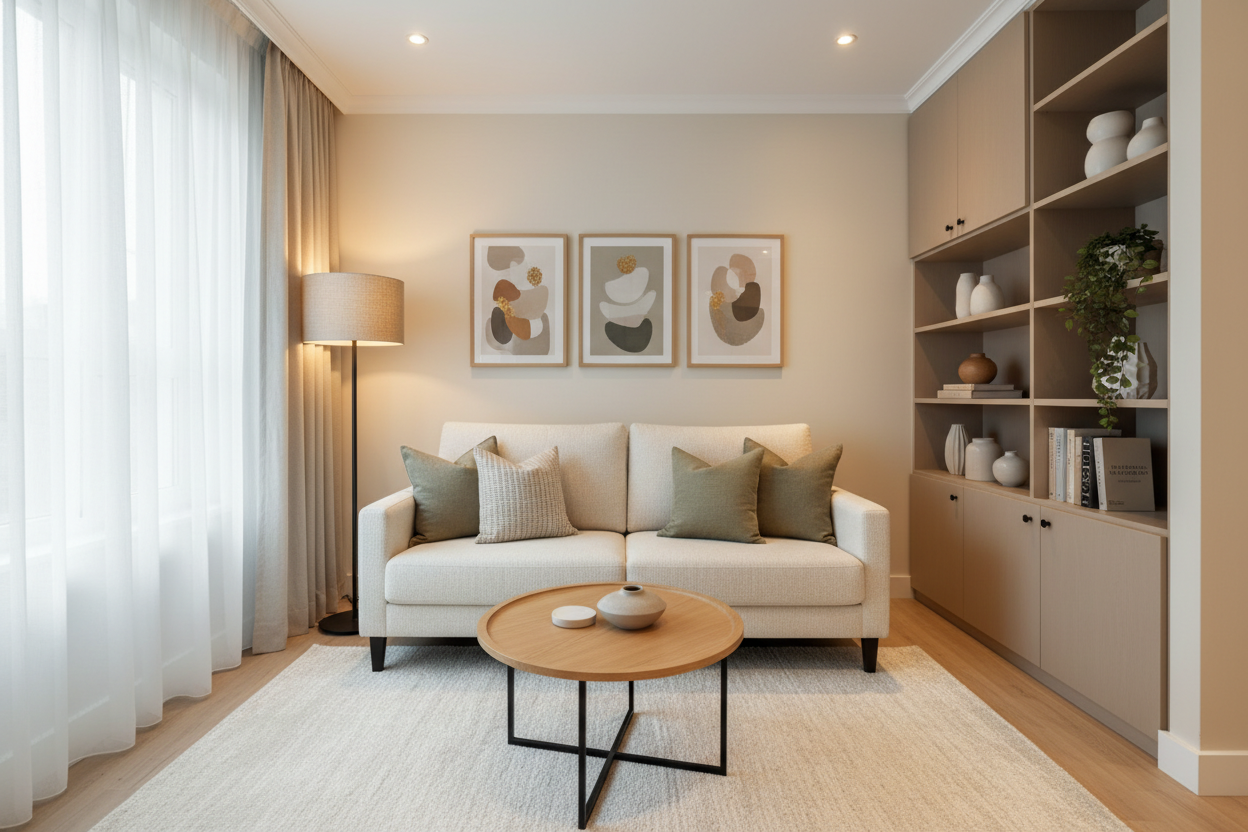
How to Make a Living Room Look Bigger: 10 Rules Architects Use
By Mattea, co-founder and Interior Architect — Restylit
How do you make a living room look bigger? With three main levers: light, proportions and visual continuity. There are no magic tricks — only optical principles that work because the brain reads space in a predictable way. Applying them well requires method, not necessarily a high budget.
Most of the things that "shrink" a living room don't depend on the square footage. They depend on wrong choices — a rug that's too small, curtains that are too short, furniture that's too large or too numerous. Remove the mistakes and the space starts breathing again, even without moving a wall.
The 3 Optical Principles Behind Everything
Before talking about mirrors and colours, we need to understand how the brain perceives space. It's not a matter of taste — it's physiology.
1. Light opens, shadow closes. A dark room seems smaller than it is. Not because it has fewer square metres, but because the eye can't read the boundaries of the space. Every shadowed corner is a boundary that feels closer. The more light there is — natural or artificial, as long as it's warm and diffused — the more the space opens up.
2. Visual continuity widens. Every interruption — a colour change, a piece of furniture blocking the view, a rug that's too small creating an isolated island — breaks the space and makes it feel fragmented, and therefore small. Continuity, on the other hand, widens.
3. Visible floor creates air. Furniture with legs lets you see the floor beneath. A visible floor makes the space feel larger because the eye perceives the surface as continuous. Furniture resting directly on the floor creates horizontal visual barriers that cut the space. Had you ever noticed that?
Hey, before we continue — take a look at our interior design consultations and book a free 15-minute call →
Now, let's get back to it!
1. Free Up the Natural Light — Before Doing Anything Else
The window is the most valuable asset in a small living room. Most people neutralise it by placing furniture in front of it, hanging heavy curtains, or both.
The right curtains for a small living room aren't the ones that "frame" the window — they're the ones that are as invisible as possible when open. Light fabrics, a colour close to the wall, a track mounted 10–15cm from the ceiling (not from the top of the window frame). When the curtains are open, they shouldn't cover the sides of the glass.
Windows need to be kept clean, inside and out — natural light filtered through a dirty pane loses 20–30% of its intensity. Obvious, but always forgotten.
2. The Rug: Bigger Than You Think
The most common mistake in small living rooms: the rug is too small.
A rug that's too small creates an "island" effect and makes everything feel more cramped. A larger one that embraces at least the main seating makes the living room look more ordered at a glance.
The rule is always the same: the front legs of the sofa must sit on the rug. A rug that holds the front legs of the sofa and surrounding seating unifies the space, defines it with purpose, and paradoxically makes it feel larger — because it eliminates visual fragmentation.
The minimum size for a small living room: at least 160×230cm. Smaller than this, in almost every context, is too small.
3. Mirrors: Where They Work (and Where They Don't)
Mirrors expand the space — but only when positioned correctly. Used badly, they reflect dark corners or create confused effects that help nobody.
Where they work:
- Opposite a window — they reflect natural light and double the room's brightness
- Along the longest wall of the living room — they visually lengthen the space
- As a tall vertical element — they draw the eye upward and make ceilings feel higher
Where they don't work:
- Opposite a solid wall with no windows — they only reflect darkness
- Low down, almost at floor level — they don't create depth, they create confusion
- Leaning against the wall instead of being hung — they take up floor space without giving the full effect
The golden rule: one large mirror always beats three small ones. Fragmentation is the enemy of a small space.
4. Wall Colour: White Isn't the Only Answer
The most common advice for small living rooms is "use light colours." It's correct — but incomplete.
Light colours reflect light and visually widen the space. But pure, cold white in a room with little natural light becomes almost metallic — it reflects in an unpleasant way and doesn't warm the space.
The best choice for a small living room: warm ivory, sandy beige, cream, very light warm grey. Tones that reflect without glaring.
The dark wall trick that actually widens: Counterintuitive, but it works. Painting a piece of furniture and the wall behind it the same tone, or choosing a dark shade for the wall behind the TV, reduces the visual impact of the furniture by making it "disappear" into the structure of the room. This trick is particularly useful in small living rooms.
A dark back wall — behind the television, or the one furthest from the entrance — creates depth. The eye perceives the wall as set further back. The room feels deeper.
Colour drenching: painting the doors, mouldings and skirting boards the same colour as the walls prevents the room from feeling broken up and fragmented by the various openings. In small living rooms with multiple doors, this technique reduces visual interruptions and gives the space coherence.
5. Furniture With Legs
Seeing the floor continue beneath furniture and storage units gives a sense of air.
A sofa with legs — even low ones, even just 10–15cm — makes the space feel lighter than one that rests directly on the floor. The same goes for storage units, bookcases and bedside tables.
The rule: in a small living room, any piece of furniture that can be raised off the floor, should be. Visible floor is perceived space.
Glass furniture or pieces with reflective surfaces work on the same principle — they don't block the view, they don't create visual barriers, and the space "passes through" them.
6. Long Curtains Down to the Floor — Always
Curtains that end halfway up the wall visually break the height of the room. Curtains that reach the floor — even in a living room with low ceilings — create the illusion of height.
The trick is to mount the track or rod as close to the ceiling as possible (not above the top of the window) and choose curtains that skim the floor. The result is a continuous vertical line that draws the eye upward and makes the room feel taller.
The ideal fabric: light, semi-transparent or raw linen. Avoid heavy velvets and dark colours — they block the light and close the space in.
7. A Continuous Floor — Without Interruptions
When the floor is fragmented by too many changes, the room breaks apart.
A uniform floor — same material, same direction — makes the space feel more continuous and therefore larger. Every change of material creates a visual boundary that cuts the space.
If you're renovating: a large-format porcelain floor (60×120cm or 60×60cm) laid continuously without excessive grout lines visually expands better than small-strip parquet or a mosaic floor.
If you can't change the floor: use a rug large enough to unify the living zone rather than fragmenting it further.
8. A Few Strong Pieces, Not Many Average Ones
A small living room can't handle too many "statement pieces." Better to choose one: a coffee table with an interesting finish, an armchair with a standout fabric, a lamp that makes an impression. Everything else should be coherent and quieter. That way the eye has a place to rest and the room feels more composed.
Too many small decorative objects create visual noise. The eye doesn't know where to look and perceives confusion. One strong element, a few supporting elements, everything else silent.
The rule of less: before adding something, ask yourself whether you're improving the space or filling it.
9. Vertical Lines Raise the Ceiling
Everything that draws the eye upward makes the room feel taller — and a taller room automatically feels larger.
Vertical stripes on walls, tall narrow artwork, decorative vertical-slat panels, and pendant lamps all draw the gaze upward, making the space feel more expansive.
In practice: a bookcase that reaches the ceiling expands more than a low one. A tall, slim pendant lamp expands more than a ceiling fixture. A tall, narrow piece of artwork expands more than a low, horizontal one.
10. Order Is a Design Choice, Not a Habit
A cluttered space looks small and claustrophobic. If the space is free of excess objects, the room feels larger.
This doesn't mean living in a catalogue-style apartment with nothing in it. It means designing the space so that every object has a place — and when it's in its place, the room works.
Furniture with integrated storage (benches with drawers, tables with compartments, ottomans with internal space) are real investments in a small space — because they allow you to maintain order without giving up your belongings.
The Mistakes That Shrink the Space — The Quick List
- Rug too small — creates visual islands instead of unifying
- Short curtains — break the perceived height
- Too many small decorative objects — visual noise
- Furniture sitting on the floor — no air underneath
- Single overhead light source — shadows that close off the corners
- Different colours in every corner — visual fragmentation
- Sofa too large — takes up physical and visual space
- Small mirrors — not enough, and sometimes make things worse
- All furniture against the walls — creates a dead void in the centre
- Partially blocked window — wastes the room's main asset
Checklist: Before Making Any Purchase
Use this checklist to assess your living room before taking action.
Light
- Is the window clear and unblocked by furniture or heavy curtains?
- Are there at least 2–3 different light sources (not just the ceiling light)?
- Are the bulbs at 2700K (warm light)?
Proportions
- Is the rug large enough to hold the front legs of the sofa?
- Do the main pieces of furniture have legs or leave the floor visible?
- Is there at least 90cm of clear circulation space between pieces?
Visual continuity
- Is the floor uniform without too many interruptions?
- Do the walls have a coherent palette?
- Do the curtains reach close to the ceiling and close to the floor?
Visual order
- Does every decorative object have a precise place?
- Is there one strong element and everything else quiet?
- Have I removed everything that isn't really needed?
The Restylit Perspective
The thing we see most often in small living rooms isn't a lack of space — it's a lack of design. Choices made one at a time, without an overall vision, that accumulate until the room closes in.
A small living room doesn't need more square metres. It needs fewer mistakes.
If you'd like a professional eye on your space before making any purchases, at Restylit we always start from the floor plan and photos — and tell you exactly what to remove, what to move, and what to add.
Restylit is an Italian interior design company, entirely online. We design living rooms, kitchens, bathrooms and complete spaces — 3D renderings, shopping lists, technical drawings. Across Italy and Europe.


