

How to Furnish a Home on a Limited Budget: Where to Put Your Money and Where Not To
How do you furnish a home on a limited budget? Certainly not by cutting uniformly across the board, but by choosing precisely where to concentrate the spending and where you can reasonably save without regrets. A €5,000 budget used well produces a better result than an €8,000 budget used badly. The difference isn't the amount — it's the hierarchy of choices.
In short: the problem for those furnishing on a tight budget is almost never a lack of money. It's the absence of a project that establishes priorities before the first purchase is made. Those who buy piece by piece waste on average 25-30% of their budget on mistakes — things they'll sooner or later regret. Those who start with a defined layout and a priority list spend less and get more.
What you'll find in this guide. The spending hierarchy by category — what has high impact and where it makes sense to invest, what has low impact and where you can cut. The five rules for allocating a limited budget well, the impact/cost summary table for each item, and why a professional project isn't a luxury even when the budget is tight. If you're furnishing and want every euro to count, this is the right guide.
The Low Budget Paradox
Before talking about money, I want to name something that nobody says clearly enough.
Those who furnish on a limited budget can't afford to make mistakes. And yet they almost always make more mistakes than those with a higher budget. Not because they're less capable — but because economic pressure pushes towards impulse purchases, flash deals and choices made without an overall vision.
The sofa bought on offer that doesn't fit the space. The rug bought because it was cheap that makes everything feel smaller (watch out for this one!). The replacement lamps that don't work with the light you already have. These mistakes, added up, are often worth 25-30% of the total budget. On a €6,000 budget, that's €1,500-1,800 in purchases that should never have been made.
The paradox could be this: those who have less money need a project more, not less.
The Spending Hierarchy: High Impact vs Low Impact
Not all spending categories have the same visual and qualitative impact on a space. Some radically change how a room is perceived. Others are details only noticed up close. On a limited budget, the rule is to invest where impact is high and cut where impact is low.
High impact — invest here
Lighting
It's the category with the best impact/cost ratio in the entire home. Bulbs at 2700K instead of cold ones: a few euros, immediate difference. A floor lamp in a corner of the living room: €80-150. A ceiling light replaced with a pendant: €100-200.
Light isn't seen — it's lived. A space with the right light seems designed even when it isn't. A space with the wrong light seems mediocre even when the furniture costs twice as much.
Wall colour
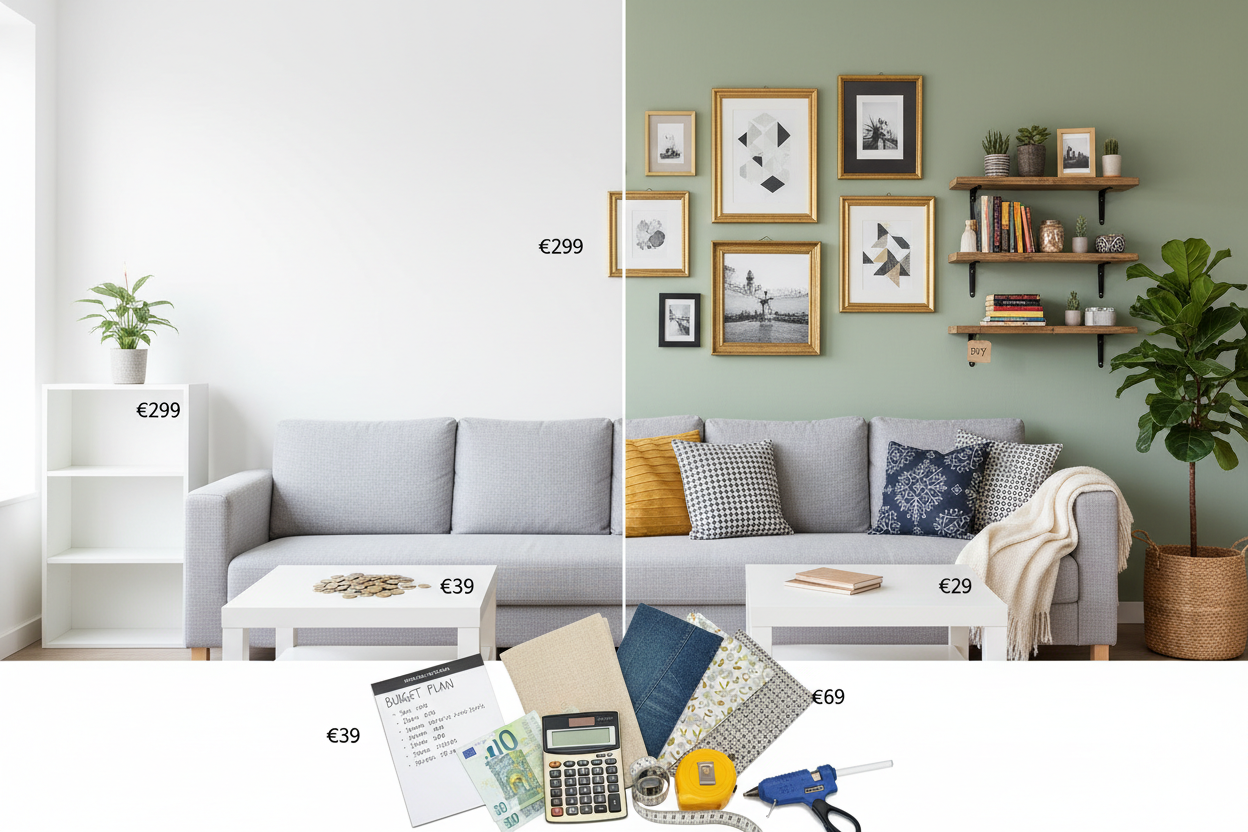
Painting one wall — even just the back wall of the living room or the one behind the headboard — is one of the highest impact/cost interventions that exists. A tin of quality paint costs €30-60. Labour, if you do it yourself, is zero. The visual result is what separates an anonymous room from a room with character.
Rule: one wall with the right colour is worth more than five new decorative cushions.
The rug
The rug is the element that more than any other unifies a space and makes the surrounding choices look considered. A rug of the right size — one where the front legs of the sofa sit on top — literally transforms the living room. It doesn't have to be expensive: there are jute or raw cotton rugs between €80 and €200 that work very well.
The mistake to avoid is buying a rug that's too small to save money. A small rug in a large space makes everything feel more impoverished, not more restrained.
The layout
Moving the furniture you already have costs nothing. But there's almost always a better configuration than the current one. The sofa doesn't have to be against the wall. The bed doesn't necessarily have to be centred on the wall. The dining table doesn't necessarily have to be where you put the dining table.
Spending an afternoon experimenting with different layouts — even just mentally, with paper and pencil, or with the help of a professional — is worth more than any new purchase.
The main piece of furniture
In every room there's a protagonist piece: the sofa in the living room, the bed in the bedroom, the bookcase in the study. That's where the spending is concentrated. A good sofa lasts fifteen years. A cheap sofa shows and feels it in six months.
The rule I always use: one strong piece and everything else quiet. Not three average pieces — one good one and two basic ones.
Medium impact — spend with judgement
Textiles
Cushions, throws, curtains. They have a real visual impact but also a high risk of excess. The problem with textiles is that they accumulate easily — you buy a cushion, then another, then the matching throw — and the result is an accumulation that makes the space look cluttered.
Rule: few textiles, coherent palette. Two colours maximum, materials that work together. Raw linen, washed cotton, wool — all work. Shiny polyester doesn't.
Decorative accessories
Vases, plants, decorative objects. The impact depends entirely on how they're used. One strong object in a corner can be enough. Ten mediocre objects scattered around the room create only visual noise.
The rule of less: before adding something, remove one. The space breathes better with fewer things, not more — I really mean this!
Low impact — cut here without regrets
Frames
Picture frames have marginal aesthetic impact relative to the content. A quality print in an IKEA frame works better than a mediocre print in an expensive frame. Invest in the content, not the container.
Bathroom accessories
The soap dispenser coordinated with the toothbrush holder and the ceramic cup. They have very low visual impact relative to their cost. If the bathroom needs attention, what really changes things is the light and the order — not the accessories.
Small decorative objects
Ornaments, candles, decorative trays. If you count them, in many homes there are twenty or thirty. The impact of each one is almost zero. The impact of them all together is often visual confusion.
And Now the Point You've Been Waiting For: The 5 Rules for Allocating a Limited Budget Well
1. Establish the hierarchy before buying anything
Write a list of everything you want to buy or change. Then put each item in one of three categories: high impact, medium impact, low impact. Start with the first category. Move to the second only if you still have budget. The third category, most of the time, isn't necessary.
2. One strong piece, everything else basic
In every room, choose one piece to concentrate the spending on. The sofa, the bed, the bookcase, the lamp. Don't save on that one — choose well and choose to last. For everything else, go functional and restrained.
3. Colour before new furniture
If the budget is really tight, the first thing to do is paint, not buy. The right colour on one wall transforms a room more than any new piece of furniture. It costs a fraction of any purchase and can be done yourself.
4. Buy secondhand for structural pieces, new for textiles
Structural solid wood furniture — tables, chairs, bookcases, bedside tables — secondhand is often better quality than new furniture in the same price range. Textiles, on the other hand, always buy new: secondhand linen is never quite the same thing.
5. Don't buy until the layout is defined
This is the most important rule and the most ignored. First define where every piece of furniture goes — even just on paper, with measurements — then buy. Not the other way around. Every purchase made without a defined layout has a high probability of being wrong.
Summary Table: Impact vs Cost by Category
| Item | Visual impact | Indicative cost | Priority on limited budget |
|---|---|---|---|
| 2700K bulbs | High | €5-15 each | First thing to do |
| Wall colour (one wall) | High | €30-80 | Second thing to do |
| Right-sized rug | High | €80-250 | Invest well |
| Protagonist piece of furniture | High | €200-800 | One strong piece |
| Floor lamp / pendant | High | €80-200 | Worth the cost |
| Textiles (cushions, curtains) | Medium | €50-200 | With judgement |
| Plants | Medium | €10-60 | One large, not ten small |
| Frames and artwork | Low | €20-100 | Cut here |
| Bathroom accessories | Low | €30-80 | Not a priority |
| Small decorative objects | Low | €10-50 each | Cut here |
Why a Project Isn't a Luxury Even on a Limited Budget
This is the part I most want to say, because it's the most counterintuitive.
When the budget is tight, the first thing to cut is the professional. It seems logical: if I have €5,000 to furnish, every euro that goes to the project is one less euro for the furniture.
It's the wrong reasoning. Here's why.
Those who furnish with €5,000 without a project make on average €1,000-1,500 in recoverable mistakes (it happens): wrong purchases, wrong proportions, choices that don't work together. The effective budget that actually reaches the right furniture is €3,500-4,000.
Those who furnish €5,000 with a Restylit Basic+3D consultation — which for a 60sqm apartment costs around €350-400 — have a photorealistic rendering of every room before making the first purchase. They see the mistakes when correcting them is free. Every purchase is validated against the overall project. The effective budget that reaches the right furniture is €4,600.
The project doesn't cost €350-400. It saves €600-1,100 compared to going without.
It's not a luxury. It's the most rational choice you can make on a limited budget.
The Right Starting Point
If you're furnishing on a limited budget and want every euro to count, the correct process is this.
First: define the layout. Paper, pencil, measurements. Where every piece of furniture goes. Before opening any furniture website.
Then: establish the hierarchy. One strong piece of furniture, the colour of one wall, the right bulbs, a rug of the correct size. In that order.
Finally: consider whether a professional consultation lets you reach the result with fewer wasted euros. Almost always the answer is yes.
At Restylit we often work with clients who have contained budgets. The starting point is always the same: understand where to concentrate the spending to get the most from what you have. The free 15-minute call is the right place to start this conversation.
FAQ
What's the minimum budget to furnish a room from scratch? It depends a lot on the room and what's already there. A living room from scratch with mid-range quality furniture requires between €2,000 and €4,000. A bedroom between €1,500 and €3,000. With a lower budget it's possible, but requires much more careful selection and strategic use of secondhand for the structural pieces.
Is it worth buying secondhand furniture on a limited budget? For structural solid wood pieces, yes, almost always. Secondhand tables, chairs, bookcases and bedside tables often have better build quality than new furniture in the same price range. For textiles and soft furnishings, always buy new.
How do you make a room look larger without spending much? The three things with the best impact/cost ratio for visually expanding a space are: 2700K bulbs (warm light expands the perception of space), a rug of the right size (not too small), and reducing the number of objects present rather than adding more. Empty space, in a small room, is an ally.
Is it better to spend more on a few pieces or spread the budget across many? Always better to concentrate on a few pieces. One strong piece and the rest basic works much better than many average pieces. The eye needs a point of reference — one or two quality elements give character to the whole room. Ten mediocre pieces never add up to a quality result.
How do you choose wall colour on a limited budget? Start with just one wall — the back wall of the living room or the one behind the headboard. Choose a warm colour, not pure white, not cold grey. Buy a tester for €5-8, paint an area of at least 30×30cm and observe it at different times of day before deciding. This is the only thing to do before buying a full tin.
Is it worth paying an interior designer on a limited budget? If the overall furnishing budget exceeds €3,000-4,000, almost always yes. The cost of a Restylit Basic+3D consultation (from €249) is more than recovered in the purchasing mistakes you avoid. With a budget below €2,000, the quick consultation packages (Basic at €129) can give valuable guidance on layout and the spending hierarchy.
Restylit is an Italian interior design company, entirely online. We design residential spaces with photorealistic 3D renderings, shoppable lists and technical drawings for the contractor — across Italy and Europe. Over 500 completed projects, 4.8/5 average.


