

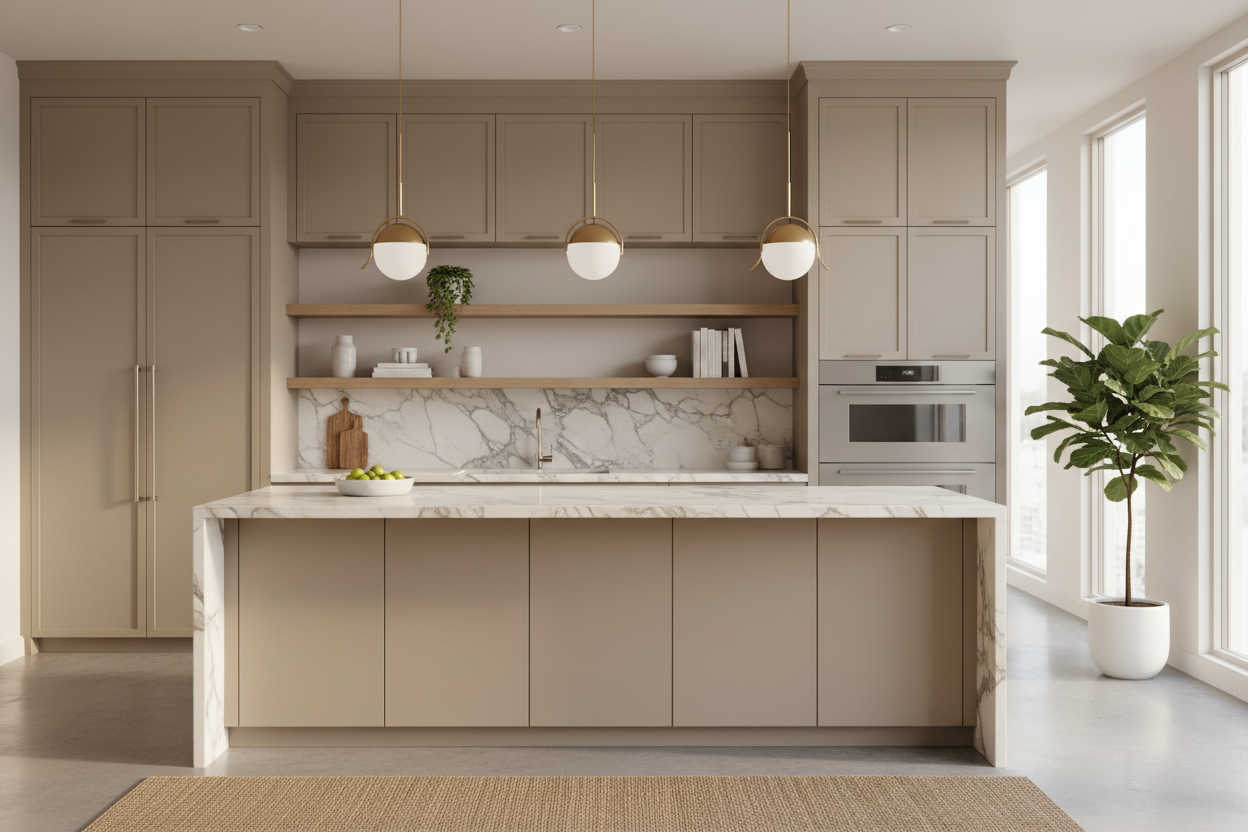
How Much Does Kitchen Renovation Cost in 2025: Real Prices, Line by Line
By Alberto, co-founder — Restylit
How much does a kitchen renovation cost? For a complete renovation of a medium-sized kitchen (8-10sqm), the real cost ranges between €8,000 and €17,000, furniture and appliances included. Labour and installation work alone, without furniture, comes to €3,000-6,000. A renovation involving relocated plumbing, structural work and designer kitchen can exceed €20,000. Below €3,000 you're doing a restyling, not a renovation.
That said, the number alone tells you nothing. What matters is understanding where that money goes, what makes a quote explode, and where you can reasonably save without regretting it later.
The Distinction Nobody Makes Clearly Enough
When people talk about "kitchen renovation" they mean very different things. And the cost changes completely depending on what's actually being done.
Restyling
You change the cabinet fronts, replace the worktop, repaint. The plumbing stays where it is, the furniture stays where it is. The visual effect can be very good, but the kitchen functions exactly as before.
Cost: €1,500-4,000. Timeline: one week.
Partial renovation
You replace the complete kitchen with a new one, redo the wall tiles, possibly change the floor. Plumbing is adapted but not relocated.
Cost: €5,000-10,000. Timeline: two weeks.
Full renovation
Everything opens up. Plumbing is relocated, the layout is modified, walls, floor, tiles are redone and a new kitchen with appliances is installed. This is the intervention that genuinely transforms the space.
Cost: €10,000-20,000 and above. Timeline: three to four weeks of work plus material delivery times.
Line by Line: Where the Money Goes
This is the part I most want to explain clearly, because it's what's almost always missing from generic quotes.
Demolition and disposal (€500-1,200)
The first line item that almost nobody puts in the initial budget. Removing the old kitchen, stripping the tiles, disposing of everything at an authorised site. It's not free and it's not quick.
Plumbing (€800-2,500)
Depends entirely on what's being done. If the sink stays in the same position, the existing plumbing is adapted and the cost is contained. If it moves even half a metre, the floor has to be opened and costs grow. If a second water point is added (island sink, filtered drinking water), costs grow further.
The practical rule: every relocation of a water connection adds €400-800 to the quote.
Electrical installation (€500-1,500)
The kitchen has more electrical loads than anywhere else in the home: oven, dishwasher, fridge, induction hob, microwave, extractor. Each lighting point and each dedicated socket has a cost. If the existing installation can't handle the new loads, it needs to be partly redone. Average cost per electrical point in a kitchen: €25-40.
Tiles and flooring (€1,500-4,000)
Depends on surface area and chosen materials. Mid-range porcelain tiles cost €20-40 per sqm in materials, plus €25-35 per sqm to install. In a 10sqm kitchen with 15sqm of walls to tile, this line alone can reach €2,000-2,500.
The splashback above the hob is the most aesthetically free-ranging item: decorative tiles, large-format porcelain, glass, steel. Prices range from €30 per sqm to €200 per sqm for special materials.
Kitchen furniture (€2,500-8,000)
The range is enormous and depends almost entirely on material quality and brand. A complete IKEA Metod kitchen for a three-metre run can be taken home for €2,000-3,000. A mid-range Italian kitchen (Scavolini, Snaidero, Ernestomeda) starts from €5,000-6,000. A bespoke design kitchen has no ceiling.
The detail that matters: the kitchen price almost never includes installation. Installing a medium-sized kitchen costs €500-1,200 depending on complexity.
Appliances (€1,500-5,000)
You can do almost everything for €1,500 choosing entry-level brands. You can also spend €5,000 on the hob alone if you go for Gaggenau or Bora. The mid-range that I see working well in most cases is around €2,500-3,000 for oven, hob, extractor and dishwasher of decent quality.
Summary table
| Item | Indicative cost |
|---|---|
| Demolition and disposal | €500-1,200 |
| Plumbing | €800-2,500 |
| Electrical installation | €500-1,500 |
| Tiles and flooring | €1,500-4,000 |
| Kitchen furniture and installation | €3,000-9,200 |
| Appliances | €1,500-5,000 |
| Total full renovation | €7,800-23,400 |
The Three Things That Make a Quote Double
In the projects we follow, when a quote doubles during the work, it's almost always for one of these reasons.
Relocating the plumbing
Deciding mid-site to move the sink, add a dishwasher connection where it wasn't planned, or bring the gas to the other side of the kitchen. Every plumbing change made during the work costs twice what it would have cost in the original project, because it means reopening what's already been closed.
The only solution: decide everything before starting. Final layout, position of every connection, every appliance, every socket. And don't change it during the work.
Hidden problems
Damp under the tiles. Electrical installation not up to code. Leaking pipes. Things that emerge only when you open up. Nobody's fault, but they need to be budgeted with a 15-20% buffer. On a €12,000 quote, keeping €1,800-2,400 aside for unexpected costs isn't pessimism: it's realism.
Changes during the work
"While we're at it, let's add the dropped ceiling." "I saw that finish and I want that one instead." Every variation made during the work has a cost that's always higher than it would have been in the original project. Not because contractors take advantage, but because modifying something already started requires more work than doing it right from the beginning.
How Much You Recover with Tax Incentives
The kitchen falls under the Renovation Bonus and the Furniture Bonus. It's worth understanding how they actually work.
Renovation Bonus (50%)
50% IRPEF tax deduction on up to €96,000 of expenditure, spread over ten years. In practice: if you spend €10,000 on building and installation work, you recover €5,000 over ten years (€500 per year less in taxes). Not immediate cash, but a real saving.
Conditions: payment by dedicated bank transfer, compliant invoices, tax return declaration. Nothing complicated.
Furniture Bonus (50%)
50% deduction on the purchase of new furniture (including fitted kitchens) up to €5,000 of expenditure, spread over ten years. Only applies if you also claim the Renovation Bonus in the same year or the previous year.
In practice: if you spend €5,000 on a new kitchen, you recover €2,500 over ten years.
Reduced VAT at 10%
On extraordinary maintenance work on residential properties, VAT drops from 22% to 10%. Applies to both labour and some materials. An automatic saving with no additional paperwork.
The Geographic Factor: How Much It Varies by City
Milan is the most expensive city, with prices 20-30% above the national average. Rome is about 20% higher, Florence 15%. Cities in Southern Italy can be 15-20% below the national average.
In practice: the same kitchen that costs €12,000 in Milan can cost €9,000 in Naples. Labour is the line item that varies most: materials have more uniform prices at national level.
How Long It Takes
Basic work takes 5-7 working days. Mid-range interventions take 10-15 working days. Complete projects take 20-30 working days.
To these times you need to add delivery times. Mid-range or custom kitchens have production times of 6-10 weeks. High-end appliances can take 4-8 weeks. If you order everything only when the work starts, the site stops and waits.
The right order is always: final project, order materials and kitchen, then start work when everything is delivered or incoming.
Where It Makes Sense to Save and Where It Doesn't
After some years of following renovation projects, I have a fairly clear idea of where saving makes sense and where it tends to cost more in the long run.
Where you can save without regrets
The splashback tiles don't need to be designer: there are porcelain tiles of excellent visual quality under €30 per sqm that hold up well over time.
A quality laminate worktop has improved enormously: to the eye you can't distinguish it from quartz or marble, and it costs a third of the price.
The extractor is a functional appliance: if you don't want a design piece, an efficient built-in extractor can be found for €150-400.
Where saving doesn't pay off
The tap. A quality mixer costs €100-300 and lasts 15-20 years. A cheap one breaks in 3-5 years and often causes leaks. The replacement cost, including labour, exceeds the initial saving.
The induction hob if that's what you want. Not all hobs are equal: the difference between a good quality hob and a cheap one is felt in daily use and seen in longevity.
The electrical installation. Not the place to take the lowest offer. An electrical installation done badly in a kitchen is a safety problem before it's an aesthetic one.
The Quote You Should Expect
A professional quote for a kitchen renovation should have these characteristics. If any are missing, ask.
Separate, detailed line items, not grouped. Not "kitchen works: €8,000." Demolition, plumbing, tiles, installation: line by line.
Reference to specific materials. Not "tiles": brand, format, reference. Not "kitchen": brand, model, configuration.
Defined timelines with estimated start and end dates.
Clear payment terms: deposit, progress payments, final balance at end of works. Never pay everything upfront.
VAT treatment clearly stated: 10% or 22%, with the reason.
If you're planning a kitchen renovation and want to understand the real budget before contacting contractors, at Restylit we do this as part of the project: definitive layout, material specifications, technical guidance to hand over to the contractor. So you arrive at the site with a quote you can compare line by line. Book a free 15-minute call →
FAQ
Is it worth renovating the kitchen before selling a property? Almost always yes, if the kitchen is clearly dated. A kitchen in good condition is one of the elements that most influences how buyers perceive a property's value. A light restyling (€2,000-4,000) almost always returns more than it costs. A full renovation is harder to amortise: it depends on the local market and the property's value.
Is it better to have a custom kitchen or a modular one? Depends on the space. A modular kitchen works well in standard spaces. In spaces with irregular corners, lowered ceilings or columns, a custom kitchen uses every available centimetre. The cost of custom is higher but not always dramatically so: depends on the joiner and the complexity.
Do I need planning permission to renovate the kitchen? For replacing the kitchen without structural modifications or relocating the gas column, in many municipalities no building permit is needed. If plumbing is relocated, a CILA declaration is almost always required. If the structure is modified, a SCIA is needed. The exact boundary depends on the municipality. It's always worth checking before starting.
How long does a well-renovated kitchen last? With mid-range materials and correctly executed installation, the kitchen structure lasts 20-30 years. Appliances need replacing sooner: 10-15 years for good quality ones. Taps after 15-20 years if quality. The worktop depends on the material: quartz lasts decades, quality laminate 10-15 years.
Can I live in the house during the work? In a partial renovation yes, with some disruption. In a full renovation that includes relocating plumbing, no. Kitchen work makes it impossible to cook for the entire duration of the site. If it's the only kitchen in the apartment, plan an alternative.
Renovating the kitchen is one of the interventions with the best ratio between investment and daily quality of life. Not because a new kitchen is more beautiful, but because a space that works well is used every day, and every day you feel the difference. The point is to get to that result without unpleasant surprises along the way.
Restylit is an Italian interior design company, entirely online. We design residential and commercial spaces with photorealistic 3D renderings, shopping lists and technical drawings, across Italy and Europe.


